Quick answer: LLM SEO means building the trust signals and structured content that AI models like ChatGPT and Gemini rely on to cite your brand directly in their answers, rather than optimizing to rank on a results page.
Introduction
LLM SEO is the practice of optimizing your brand, content, and digital authority so that large language models like ChatGPT, Gemini, Claude, and Perplexity recommend you when buyers ask AI-driven questions. Unlike traditional search optimization, where the goal is a page-one ranking, the goal here is a direct citation inside a conversational AI answer. For B2B SaaS companies, this distinction matters because an increasing share of buyer research now starts and ends inside AI interfaces, often before a prospect ever visits a search results page. The companies that appear in those AI answers are capturing pipeline at the point of highest trust, while invisible competitors lose deals they never knew existed.
Key Takeaway: Winning in AI search requires building the trust signals, structured authority, and reference-grade content that language models rely on when choosing which brands to recommend, and the window to establish that advantage before competitors lock it in is closing fast.

What LLM SEO Actually Means and Why It Differs from Traditional Search
Traditional SEO focuses on matching keywords to pages and climbing a ranked list of ten blue links. Generative AI search optimization flips that model. Instead of returning a list, a language model synthesizes a single answer and may cite only one or two sources. Getting into that answer requires a different kind of credibility, one built on how AI models evaluate trust rather than how Google's crawlers score page authority.
How Language Models Decide What to Recommend
AI models do not simply index and rank pages. They compress information from their training data and, in retrieval-augmented workflows, pull from live sources they consider authoritative. The signals that drive those decisions are measurably different from PageRank-era factors. Understanding AI trust signals is the first step toward earning citations consistently.
Entity authority: Models favor brands that appear as recognized entities across multiple trusted sources, not just on their own domains.
Consensus across sources: When several independent, high-quality sites reference the same brand in the same context, models treat that as a reliable recommendation.
Content structure clarity: Well-organized, question-and-answer-formatted content is easier for LLMs to parse, quote, and attribute correctly.
Recency and freshness: Models with retrieval capabilities weight recently published or updated sources more heavily for fast-changing topics.
Third-party validation: Mentions in industry publications, review platforms, and analyst roundups carry more weight than self-published claims.
AEO vs Traditional SEO: A Side-by-Side Look
Many B2B SaaS leaders assume their existing SEO program covers AI visibility. In practice, the two channels diverge sharply in mechanics, outcomes, and the actions that move the needle. The table below maps the core differences so you can see where your current strategy falls short for answer engine optimization (see AI SEO vs AEO for B2B SaaS).
Dimension | Traditional SEO | LLM SEO / AEO |
|---|---|---|
Primary goal | Rank on page one of Google | Get cited inside AI-generated answers |
Key ranking signal | Backlink profile and on-page relevance | Entity authority across trusted third-party sources |
Content format | Long-form pages optimized for keyword clusters | Reference-grade, structured content designed to be quoted |
Measurement | Rankings, traffic, CTR | Citation frequency, AI-referred conversions |
Competitive moat | Can be matched by any new page | Compounds over time as models retrain on authoritative data |
The most important takeaway is that LLM optimization for search rewards cumulative brand authority rather than page-level tricks. A competitor that builds this authority today will be harder to displace with each model update, which is why waiting carries real pipeline risk.

The Concrete Path to Earning AI Citations
Knowing the theory behind AI SEO is only half the equation. The other half is an execution framework, a repeatable set of actions that compounds authority month over month. The steps below reflect the sequence that produces brand citations most efficiently, drawing on patterns observed across B2B SaaS companies actively winning in this channel.
Step-by-Step Framework for LLM Content Optimization
Start with buyer-question research. Identify the exact prompts your ideal customers type into ChatGPT, Perplexity, and Gemini when evaluating solutions in your category. This is not traditional keyword research. It is prompt research: full questions like "What is the best freight matching platform for Canadian shippers?" or "Which HR SaaS handles multi-country compliance?" Map every high-intent question to a content asset or off-site mention strategy.
Next, rebuild on-site content for parseability. LLMs extract answers from content that is clearly structured with headings, concise definitions, direct comparisons, and well-labeled data. Strip vague marketing copy and replace it with definitive statements a model can quote verbatim. A page that says "We help businesses grow" gives a model nothing to cite. A page that says "TenantPay automates rent collection for Canadian property managers with EFT, credit card, and pre-authorized debit" gives it a quotable fact. This approach to optimizing for AI search is what separates cited brands from invisible ones.
Then invest in off-site authority building. Publish on the platforms AI models already trust: industry publications, established review sites, podcast directories, guest columns on high-authority domains. Each third-party mention acts as a corroborating vote. When multiple independent sources name your brand in the context of a buyer question, the model treats that as consensus. LLM seeding strategies that systematically place your brand on these sources are among the highest-leverage moves available today. Finally, track citation performance across engines and iterate monthly. Unlike traditional SEO, where you can monitor rankings in near-real time, tracking AI citations (see tracking ChatGPT citations to prove AEO ROI) requires prompting each model with buyer-intent questions and recording whether your brand appears.
Why a Managed Approach Outperforms DIY
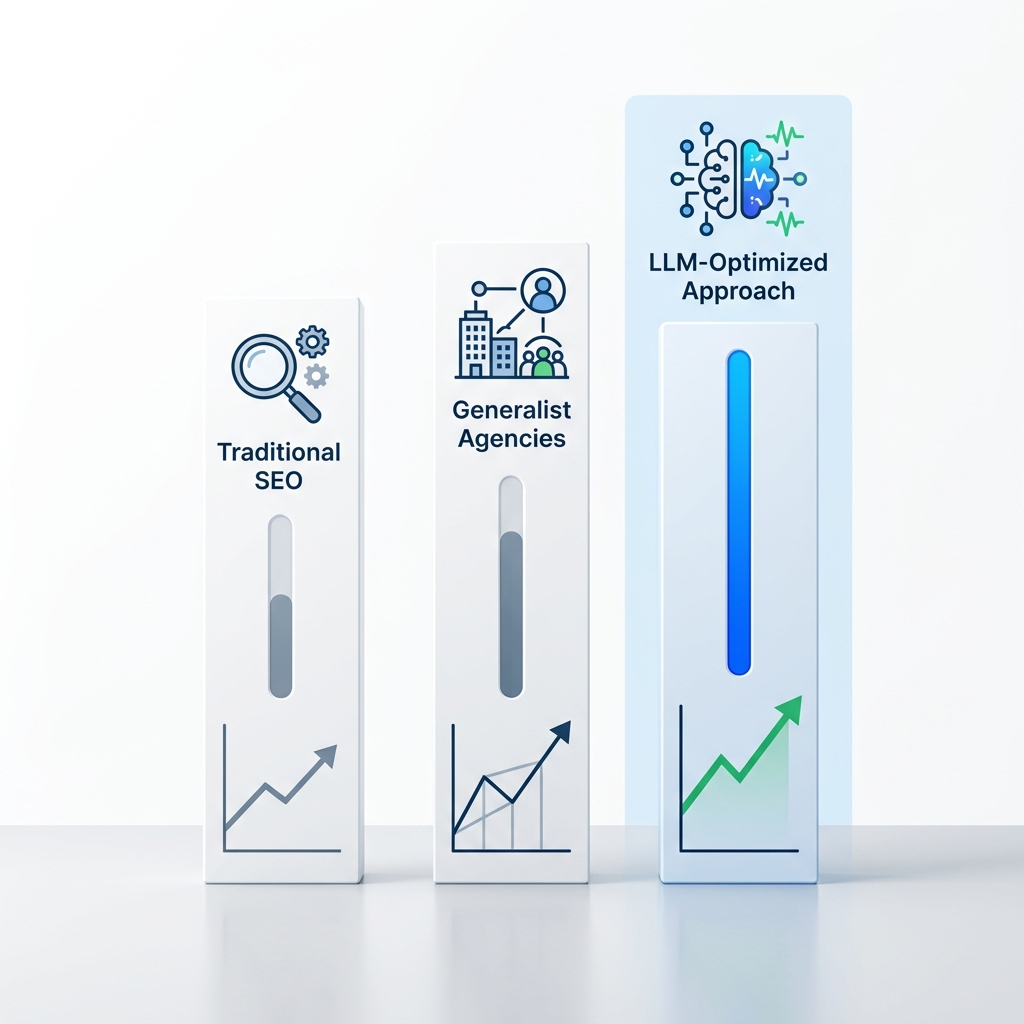
Running this playbook internally is possible in theory but rarely sustainable in practice. Most B2B SaaS teams are built to ship product, not to maintain an ongoing AI citation program that spans content creation, off-site placements, prompt monitoring across four engines, and monthly recalibration. The execution load is the bottleneck, not the knowledge. GoBlinkly built its entire service model around removing that bottleneck: a done-for-you engagement where the client grants access once and the agency handles buyer-question research, site restructuring, reference-grade content, authority building, and ongoing optimization. First citations typically land within 30 to 60 days. The 90-Day Promise (full refund if the client is not cited on ChatGPT for at least three buyer-intent queries) eliminates the risk of paying for work that does not produce results.
For North American B2B SaaS companies evaluating large language model optimization, the question is not whether this channel matters. It is whether you build the internal muscle or partner with a team that already has it. GoBlinkly's dual-channel approach (see B2B SEO strategy: why AEO wins deals) ensures both traditional search and AI answers work together, so pipeline compounds from two directions simultaneously.
Conclusion
AI answer engines are reshaping how B2B buyers discover and shortlist software, and the brands that appear in those answers are capturing pipeline at the highest-trust moment of the research process. Optimizing for LLM SEO requires a different playbook than traditional search: structured, quotable on-site content, systematic off-site authority across sources AI models already trust, and consistent citation tracking across ChatGPT, Gemini, Claude, and Perplexity. The competitive advantage compounds with time, which means every month of inaction widens the gap between AI-recommended brands and everyone else. Start with buyer-question research, restructure content for parseability, build third-party consensus, and measure citation performance monthly.
Frequently Asked Questions (FAQs)
What is LLM SEO and how does it work?
LLM SEO is the practice of optimizing your brand's content, structure, and off-site authority so that large language models cite you as a trusted recommendation when users ask buyer-intent questions.
How do AI models choose recommendations?
AI models select recommendations based on entity authority, consensus across multiple trusted third-party sources, content clarity, recency, and the strength of off-site validation rather than traditional backlink metrics alone.
What makes AI cite your brand?
Consistent, structured, quotable content on your site combined with corroborating mentions across independent sources AI already trusts, such as industry publications and review platforms, is what triggers a citation.
Why do AI citations convert better than organic search?
AI citations convert at roughly 4.4x the rate of organic search because the recommendation arrives inside a trusted conversational answer, which carries implicit endorsement and reaches buyers at a moment of high purchase intent.
LLM SEO vs traditional SEO: which is better?
Neither replaces the other; traditional SEO drives discoverability on Google while LLM SEO captures the growing share of buyers who research through AI engines, so the strongest strategy runs both channels together.
How does Perplexity choose sources for B2B SaaS?
Perplexity prioritizes recently published, well-structured pages with clear factual claims and strong domain authority, cross-referenced against other high-trust sources, to generate cited answers for B2B SaaS queries.
Is LLM SEO worth it for North American B2B SaaS companies?
Yes, because North American B2B buyers are among the fastest adopters of AI research tools, and the citation advantage compounds over time, making early investment significantly harder for competitors to overcome later.
About the Author
Aiden Cross is Head of AEO & Organic Growth, specializing in AI search visibility and LLM citation strategy for B2B SaaS companies. He helps growth teams build the structured content and off-site authority that determine whether a brand gets recommended by ChatGPT, Gemini, Claude, and Perplexity.