Introduction
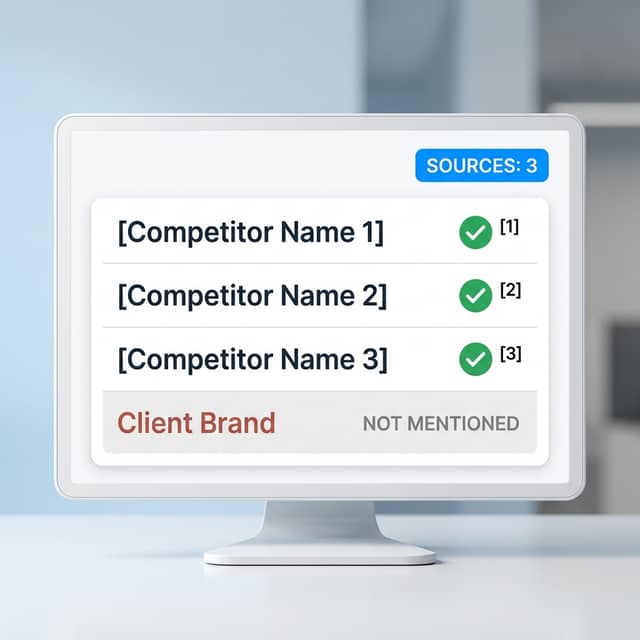
The way buyers research software has fundamentally changed. Instead of scrolling through ten blue links on Google, B2B decision-makers now ask ChatGPT, Claude, Perplexity, and Gemini direct questions like "What's the best CRM for mid-market SaaS?" and trust the cited recommendations they receive. Understanding the AI ranking factors behind those citations is no longer optional for marketing teams that want pipeline influence. The challenge is that most companies are still optimizing for an ecosystem built around crawlers and backlinks, while a parallel system governed by trust signals, semantic depth, and content structure now determines which brands get named and which get ignored.
The gap between brands that understand answer engine optimization and those that do not is widening every quarter. AI ranking factors are the trust signals, content structure choices, and semantic depth indicators that determine whether AI answer engines cite a brand in their responses. Unlike Google, AI models do not evaluate backlinks or keyword density. They assess source credibility, topical authority, and how well content is structured for machine extraction. In 2026, getting cited by ChatGPT and Perplexity requires a different optimization strategy than ranking on Google.

Trust and Authority: The Foundation of AI Citations
AI models do not rank pages. They synthesize answers from a learned understanding of which sources are credible, consistent, and contextually relevant. Before any content structure or keyword strategy matters, the model must first recognize a brand as trustworthy enough to cite, and that trust is earned through a specific set of signals that differ meaningfully from traditional search authority.
How AI Models Evaluate Source Credibility
Large language models develop an internal representation of source reliability based on patterns observed during training and retrieval. If a brand is consistently referenced across high-quality publications, technical documentation, peer-reviewed research, and respected industry media, the model learns to associate that brand with expertise in a given domain. This process is closer to reputation inference than it is to domain authority scoring.
Cross-source consistency: When multiple independent, credible sources say the same thing about a brand, the model treats that consensus as a trust signal.
Recency of mentions: AI models with retrieval-augmented generation (RAG) capabilities weigh recently published content more heavily, meaning dormant brands lose citation momentum . A 13-month Search Engine Land study published in February 2026 found that AI referral traffic tripled across 2025, confirming that brands publishing consistently earn citation momentum while dormant brands fall out of rotation.
Editorial context: Being mentioned in a product comparison, analyst report, or industry roundup signals contextual relevance far more than a passing brand mention in a generic listicle.
Factual accuracy track record: Brands whose content contains verifiable claims, real data, and properly cited statistics accumulate trust over time within the model's learned patterns.
AEO vs Traditional SEO: Authority Signals That Actually Differ
In traditional SEO, authority is largely a function of backlink profiles, domain age, and topical relevance scored at the page level. AI citation strategy requires a different lens. Models do not pass PageRank or evaluate anchor text ratios. They assess whether a source consistently provides accurate, well-structured, and substantive answers to the kinds of questions users ask. A SaaS company with 10,000 backlinks but shallow, sales-oriented content may never appear in an AI response, while a competitor with fewer links but deeper, answer-rich content earns citations repeatedly.
This distinction is why the shift from traditional SEO to AI search optimization (see GEO vs AEO vs SEO in 2026) requires teams to rethink what "authority" means. Authority is no longer about who has the most links pointing at them. The real question is who the model has learned to rely on for accurate, complete information within a specific topic domain. Gartner's 2026 B2B buyer research found that 45 percent of buyers used generative AI to shortlist vendors before any contact with a sales team (see how generative AI changes B2B buyer research). Agencies like GoBlinkly have built their entire service model around this distinction, focusing on semantic depth and content architecture rather than traditional backlink acquisition.

Content Architecture and Semantic Relevance: What AI Actually Reads
Even brands with strong reputations can be invisible to AI engines if their content is not structured for machine comprehension. AI models process content differently than search engine crawlers, and the architecture of the information on a page directly affects whether a model extracts, synthesizes, and cites it. Building an AI-first content strategy means designing pages that serve both human readers and the inference layer of a language model.
Structuring Content for AI Consumption
AI engines parse content by looking for clear, hierarchical organization that maps directly to the intent behind a user's query. Pages that bury their core answers beneath long introductions, vague section headers, or walls of undifferentiated text make it harder for the model to extract a citable passage. The best practices for AI engine optimization center on making every section of a page independently useful.
Headings should function as direct questions or precise topic declarations, not clever marketing phrases. Each section should open with the most important claim or answer, followed by supporting evidence or explanation. Lists, definitions, and structured comparisons help models parse content into discrete, retrievable units. According to research on how language models handle structured inputs, clear formatting significantly affects retrieval accuracy and the likelihood that a passage gets selected for synthesis.
Semantic SEO for AI: Going Beyond Keywords
Traditional keyword optimization targets specific phrases that crawlers match against a search index. This approach operates on a fundamentally different axis. Models do not match keywords; they interpret meaning. When a buyer asks Perplexity "What CRM handles complex B2B deal cycles?", the model is not looking for pages that contain that exact phrase. The model is searching for content that demonstrates deep conceptual coverage of B2B deal cycles, CRM functionality, and workflow complexity.
This means that topical authority, which is the breadth and depth of coverage a brand provides across a subject area, becomes a critical ChatGPT ranking factor. Brands that publish a single blog post about their product category will rarely be cited. A B2B project management tool that only publishes one article about its core feature will lose to a competitor that covers deal cycle complexity, stakeholder management, reporting, and integrations because the model has learned to rely on the broader source.
Those that build interconnected content ecosystems covering every facet of their domain, from buyer education to technical specifications to competitive comparisons, train the model to view them as a comprehensive source. The result is a compounding advantage: the more high-quality content that reinforces a brand's expertise, the more likely the model cites that brand for related queries. Companies like GoBlinkly specialize in building exactly this kind of interconnected authority architecture through managed answer engine optimization programs designed specifically for B2B SaaS companies.
One GoBlinkly client in the Canadian freight and logistics space traced its first AI-sourced leads back to ChatGPT within weeks of starting an AEO program, with those leads arriving already knowing the brand and the problem it solved.Understanding semantic search principles helps marketing teams grasp why covering topics comprehensively matters more than targeting individual keywords in an AI-driven discovery environment.

Conclusion
AI engines cite brands that earn trust through consistent, accurate, and well-structured content distributed across credible sources. The AI ranking factors that matter most, including source credibility, content architecture, semantic depth, and topical authority, reward brands that invest in being genuinely useful rather than just optimized. For B2B SaaS teams evaluating their visibility in this channel, the starting point is an honest audit of whether current content answers real buyer questions with the depth and structure that AI models can reliably extract. GoBlinkly helps B2B SaaS companies build this foundation through its managed AEO programs, turning invisible brands into the ones AI engines recommend by name. The competitive window for establishing authority in AI responses is narrow, and the brands that move now will be the ones cited when it matters.
Explore how GoBlinkly's AEO services can position your brand for AI citation across ChatGPT, Claude, Perplexity, and Gemini.
About the author: This article was written by the GoBlinkly content team. GoBlinkly is a Montreal-based agency that helps established B2B SaaS companies get cited by ChatGPT, Claude, Perplexity, and Gemini.
Frequently Asked Questions (FAQs)
What are AI ranking factors?
AI ranking factors are the signals, including source credibility, content structure, semantic relevance, and cross-source consistency, that determine whether AI answer engines like ChatGPT or Perplexity cite a brand in their responses.
How do AI engines decide which sources to cite?
AI engines select sources by evaluating patterns of trust learned during training and retrieval, favoring content that is accurate, well-structured, and consistently referenced across multiple credible publications.
How do you get cited in ChatGPT responses?
Getting cited in ChatGPT requires building topical authority through comprehensive, answer-oriented content that is independently validated by third-party sources and structured for easy machine extraction.
How is AI ranking different from Google ranking in Canada?
Google ranking relies heavily on backlink profiles, technical page signals, and click-through behavior, while AI ranking depends on semantic depth, source reputation, content structure, and how consistently a brand is referenced across the web.
Which AEO strategy works best for B2B SaaS companies?
The most effective AEO strategy for B2B SaaS combines buyer-intent content mapping, structured content optimized for AI extraction, authority building through digital PR, and ongoing monitoring of citation performance across major AI engines.