Introduction
Most B2B SaaS teams assume that producing high-quality content is enough to earn AI answer engine citations. The reality is far less forgiving. AI models like ChatGPT, Claude, Perplexity, and Gemini evaluate sources through a layered set of trust signals that determine which brands get cited and which get ignored, regardless of content quality. These AI trust signals citations rely on go far beyond traditional SEO metrics like domain authority or keyword density. Understanding what separates a cited brand from an invisible one requires examining the specific mechanics of how large language models retrieve, evaluate, and surface information.
In short: AI models trust sources that demonstrate topical consistency, structured content, quality backlinks, and strong entity recognition. A brand that satisfies more of these signals wins citations. A brand that ignores them stays invisible regardless of how well-written its content is.

The Trust Signals AI Models Actually Evaluate
The common misconception is that AI citation selection is random or unpredictable. It is neither. When an AI model generates a response and selects sources to reference, it follows a pattern of evaluation that prioritizes certain content attributes over others. These attributes function as a trust hierarchy, and brands that satisfy more layers of that hierarchy consistently win citation placement.
Core Authority Indicators
AI models assess the credibility of a source through multiple overlapping signals before surfacing it in a response. Research into trust and safety in large language models confirms that these systems are designed to favor sources that demonstrate consistent expertise. The following indicators carry the most weight in citation authority building AI systems rely on:
Topical consistency: Pages that cover a subject comprehensively across multiple related pieces signal deeper expertise than isolated articles on scattered topics.
Backlink quality over quantity: Links from recognized industry publications, research institutions, and established SaaS directories carry far more weight than bulk directory submissions or low-relevance guest posts.
Content freshness: AI models favor sources that have been recently updated, particularly for topics where accuracy degrades over time, such as pricing comparisons or regulatory guidance.
Structured data and schema: Pages that use FAQ schema, how-to markup, and clear heading hierarchies are easier for AI retrieval systems to parse and extract answers from.
Entity recognition: When a brand name is consistently associated with specific topics across multiple authoritative sources, AI models begin treating that brand as a recognized entity within that domain.
Why Good Content Alone Falls Short
Many marketing teams invest heavily in producing well-written, accurate content and then wonder why competitors with seemingly similar output appear in AI answers while they do not. The gap typically lies not in content quality but in how that content is structured, distributed, and connected to broader authority signals. A well-researched article buried on a domain with no topical cluster around it sends weak signals to retrieval systems. AI models do not evaluate pages in isolation. They evaluate the relationship between a page, its surrounding content ecosystem, and the external references pointing to it. This is why an AEO content strategy that addresses the full signal chain consistently outperforms content-only approaches.

How Semantic Authority and Entity Recognition Drive Citation Selection
Beyond surface-level quality checks, AI models rely heavily on semantic understanding to determine which sources deserve citation. This is where the gap between traditional SEO and effective AEO citation strategy becomes most visible. Two brands can target the same keyword, but the one that builds semantic authority around a topic cluster will consistently win the citation.
Semantic Citation Optimization in Practice
Semantic citation optimization refers to the practice of structuring content so that AI models can clearly identify the expertise, scope, and relevance of a source relative to a query. Unlike keyword matching, semantic evaluation looks at how well a page covers the conceptual space around a topic. A page about "B2B SaaS onboarding" that also addresses related concepts like user activation rates, time-to-value metrics, and churn prevention signals deeper expertise than one that only defines onboarding in generic terms.
This is directly connected to how named entity recognition works within NLP pipelines. When AI models process web content during training or retrieval, they identify and tag entities: companies, people, products, and concepts. Brands that appear consistently alongside their core topic entities across multiple high-quality sources build what researchers call entity salience. The more salient your brand is within a topic cluster, the more likely an AI model will reference you when generating answers in that domain. Understanding semantic SEO versus keyword SEO is essential for teams trying to build this kind of layered authority.
How ChatGPT and Perplexity Handle Citations Differently
Not all AI answer engines evaluate sources identically. ChatGPT citations tend to draw from its training data, supplemented by browsing when the feature is enabled, favoring sources it encountered frequently during pre-training and fine-tuning phases. This means that content indexed and referenced before the training cutoff date carries persistent influence. Perplexity AI citation behavior, by contrast, operates more like a real-time search engine that retrieves and ranks live web results for each query, meaning freshness and structured content carry even more weight.
Claude takes a more conservative approach, often declining to cite specific sources unless it has high confidence in their accuracy. Gemini integrates tightly with Google's search infrastructure, which means that traditional ranking factors like page experience and crawlability (see AI ranking factors that actually determine your visibility) play a larger role. For B2B SaaS companies, the takeaway is that optimizing for a single AI model is insufficient. A durable strategy must account for the retrieval and evaluation differences across all major engines. Research into how large language models handle attribution reinforces that citation behavior varies significantly between model architectures.
Building a Repeatable System for AI Citation Wins
Knowing the trust signals is only valuable if you can translate that knowledge into a repeatable process. Most B2B SaaS teams struggle not because they lack awareness, but because they lack the operational framework to address all of these signals simultaneously. The following priorities, ordered by impact, form the foundation of an effective approach to getting content cited by AI engines.
Prioritizing Your Citation Optimization Actions
Start with content structure. Before investing in new content production, audit existing pages for clear heading hierarchies, FAQ schema, and concise answers to common buyer-intent questions. AI retrieval systems extract answers from well-structured pages far more reliably than from long-form content with buried insights. Every key page should answer at least one specific question within the first 200 words.
Next, build topical clusters. Isolated blog posts send weak authority signals. Group content around core themes that map to the questions your buyers ask during their research phase. Each cluster should include a pillar page and supporting content that links back to it, creating a semantic web that AI models can traverse. Answer engine optimization depends on this kind of interconnected content architecture. After building clusters, invest in backlink quality through digital PR, earned media, and contributions to recognized industry publications. Quantity matters far less than relevance and authority of the linking domain. Finally, monitor citation presence monthly across ChatGPT, Perplexity, and Gemini for your top ten buyer-intent queries. Document which queries return your brand, which return competitors, and which return no results at all. Those gaps are your next content priorities.
Why Managed AEO Outperforms DIY Approaches
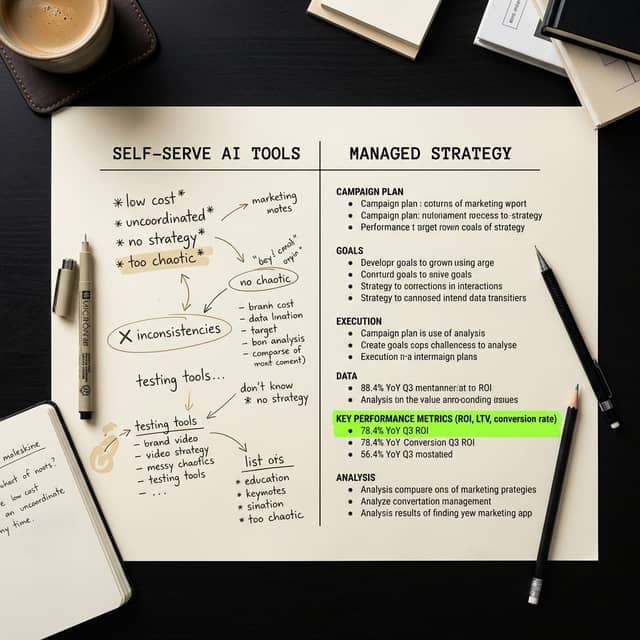
The challenge for most SaaS leadership teams is that citation optimization services span multiple disciplines: technical SEO, content strategy, digital PR, and ongoing monitoring of how AI engines decide visibility. Executing all of these in-house requires dedicated headcount and specialized tooling that most growth-stage companies do not maintain. This is where a focused partner becomes valuable.
GoBlinkly, a Montreal-based answer engine optimization agency, specializes exclusively in getting B2B SaaS companies cited by AI answer engines. Their managed approach covers buyer-question research, website restructuring for AI consumption, ongoing content production, and authority building, all calibrated to the specific trust signals that drive AI citation selection. For teams that recognize the strategic importance of AI visibility but lack the bandwidth to build and maintain the system internally, a managed approach removes the operational friction while delivering measurable citation outcomes.

Conclusion
AI models do not cite sources randomly. They evaluate a structured hierarchy of trust signals that includes topical authority, content structure, entity recognition, backlink quality, and freshness. B2B SaaS companies that treat citation as a systematic discipline rather than a content marketing afterthought will consistently outperform competitors in AI-driven buyer research. The brands winning AI-optimized citation placement today are the ones investing in the full signal chain, not just the content layer. For teams ready to move from invisible to cited, GoBlinkly offers a managed path to building the authority AI models reward.
Explore how GoBlinkly can help your B2B SaaS brand earn consistent AI citations at goblinkly.com.
Frequently Asked Questions (FAQs)
Why do AI models trust certain citations over others?
AI models trust citations from sources that demonstrate consistent topical authority, high-quality backlinks, structured content, and strong entity recognition across the web.
How does ChatGPT decide which sources to cite?
ChatGPT selects sources based on patterns learned during training, favoring content that appeared frequently on authoritative domains with clear topical relevance to the query.
What is answer engine optimization?
Answer engine optimization (AEO) is the practice of structuring and distributing content so that AI-powered answer engines cite your brand as a trusted source in their responses.
How do Perplexity and Claude handle citations differently?
Perplexity retrieves and ranks live web results in real time for each query, while Claude takes a more conservative approach and only cites sources when it has high confidence in their accuracy.
What makes a citation credible to AI?
A citation becomes credible to AI when the source consistently covers a topic in depth, is referenced by other authoritative domains, uses structured data, and maintains content freshness.