Quick Answer
B2B buyers now start vendor research inside ChatGPT, Claude, Perplexity, and Gemini, and if your SaaS is not cited in those answers, a competitor is closing that opportunity before you know it exists (see building brand awareness inside AI search). AI search optimization, also called answer engine optimization, is the discipline of earning those citations through buyer-question research, AI-parseable site structure, reference-grade content, and off-site authority on sources these models already trust.
Introduction
By mid-2026, the first vendor shortlist a B2B buyer sees is often generated by an AI answer engine, not a Google results page. When a CFO asks ChatGPT which payroll platform fits a 200-person company, or a product lead asks Perplexity to compare three data warehouses, the models return a handful of named companies and reasons to trust them. If your SaaS is not one of those names, you are not being outsold, you are being omitted. That omission is quiet, it compounds daily, and it is invisible in your Google Analytics dashboard.
Key Takeaways:
AI answer engines now shape B2B shortlists before a sales conversation ever happens, and non-cited vendors are invisible during that window.
Answer engine optimization earns citations through buyer-question research, AI-parseable content, and authority on the third-party sources models already trust.
A managed AEO partner with a citation-based guarantee moves faster than generalist SEO agencies or in-house builds that stall inside quarterly planning cycles.

Why AI Answer Engines Now Control the B2B Shortlist
Generative AI has moved from a curiosity to a primary research surface for software buyers. Harvard Business Review reporting on generative AI disrupting B2B buying shows procurement teams now use answer engines to build initial vendor lists, pressure-test category claims, and eliminate options before a demo request is ever sent. The evaluation is happening in a conversation you cannot see.
How AI Buyer Research Actually Unfolds
A typical software buyer no longer starts with a category search. They start with a question in natural language, ask a follow-up, then ask the model to compare the top three names it just gave them. That entire loop happens outside your funnel, and the vendors named early gain a structural advantage that persists through the rest of the evaluation. Understanding the AI-driven buyer research process is now foundational to any credible pipeline strategy.
Question-first entry: Buyers phrase problems, not keywords, and models respond with named recommendations rather than blue links.
Compressed shortlist: AI answers typically surface three to five vendors, so the middle of the pack in traditional SEO becomes invisible in AEO.
Citation as trust signal: Buyers treat a model's recommendation as pre-vetted, giving cited vendors an authority premium before the first call.
Silent elimination: Uncited vendors never appear, never get benchmarked, and never learn they were considered.
Why Your Competitors Are Cited and You Are Not
Models decide who to recommend based on how consistently a brand is described, cited, and structured across the sources they were trained on and continue to crawl. Competitors already investing in AEO have seeded the exact buyer questions, published quotable reference content, and earned mentions on the third-party sites answer engines lean on for validation. There are concrete reasons why ChatGPT cites competitors instead of your brand, and none of them are about how good your product is. GoBlinkly runs a free competitor visibility audit that surfaces the exact buyer queries where a rival's name is showing up and yours is missing, before any pricing conversation.

How AEO Actually Works, and Why It Is Not SEO
Answer engine optimization shares vocabulary with SEO but operates on different mechanics. Traditional SEO optimizes for a ranked page; AEO optimizes for a cited sentence inside a generated answer. The two channels overlap, but the tactics that move each are distinct.
The Mechanics That Move Model Recommendations
HubSpot's guide to answer engine optimization best practices outlines the shift clearly: models pull from structured, quotable, well-attributed content that repeatedly co-occurs with the entities and questions they are asked about. Ranking on page one is neither necessary nor sufficient. What matters is being the clearest, most citable authority on a specific buyer question across the sources the model already trusts. The gap between AEO vs SEO fundamentals is where most in-house teams stall, because their content calendar still assumes a Google-first buyer.
Dual Channel Visibility as a Compounding Asset
Treating AEO and SEO as one system is what turns citations into a durable moat. Strong technical SEO makes a site parseable for models, and reference-grade content earns both rankings and quotes. Off-site authority on the third-party publications answer engines reference feeds both channels at once. HubSpot's practical guidance on AI search visibility reinforces that the discipline is multi-surface, requiring platform-aware optimization across ChatGPT, Gemini, Copilot, and Perplexity rather than a single-engine bet.
What a Managed AEO Engagement Looks Like in 2026
The category has matured into a real operational discipline, not a content experiment. A credible AEO engagement runs continuously, measures citations rather than rankings, and holds itself accountable to buyer-intent queries that map to pipeline.
The Four Workstreams That Produce Citations
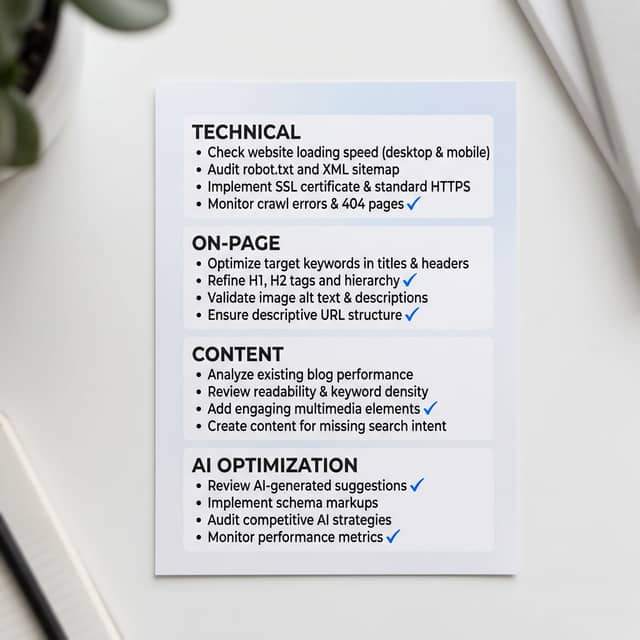
A serious program covers buyer-question research to map the exact prompts prospects type into models, a site rebuild so answer engines can parse and quote your pages cleanly, reference-grade content designed to be the source a model reaches for, and off-site authority on the third-party publications AI already treats as trustworthy. GoBlinkly runs all four as a fully managed service, with first citations typically landing in 30 to 60 days and compounding from there. To verify progress, teams need a way to track AI citations across platforms rather than relying on traffic proxies.
What to Expect in the First 90 Days
Timelines matter because AEO compounds, and every month a competitor is cited and you are not widens the gap. A well-run engagement produces its first buyer-intent citations inside the first two months, then expands category coverage and defends the positions already won. Semrush data from 2025 pegs AI-referral conversion at roughly 4.4 times the rate of organic search, which is why even a small number of high-intent citations changes pipeline economics quickly. Practical guidance on how to get your brand cited by AI during active buyer research (see AEO guide: how to get cited by AI) is the difference between a program that produces revenue and one that produces reports. GoBlinkly backs its work with a 90-Day Promise: if the client is not cited on ChatGPT for at least three industry-relevant, buyer-intent queries within 90 days, they receive a full refund and keep every asset produced.

Conclusion
The B2B buying journey has quietly reorganized itself around AI answer engines, and the vendors cited during that research window are the ones getting on shortlists in 2026. Waiting another quarter to address this hands competing vendors a compounding advantage that becomes harder to unwind every month. The move is to treat AEO as a standing operational discipline, measure citations against buyer-intent queries, and choose a partner or internal system that can execute continuously rather than in bursts. Whether the team runs this in-house or hands it to a specialist like GoBlinkly, the priority is the same: be the name the model recommends when a buyer asks who to trust.
Curious which buyer questions are naming your competitors instead of you? Run a free competitor visibility audit with GoBlinkly to see exactly where your SaaS is missing from AI answers across ChatGPT, Claude, Perplexity, and Gemini.
Frequently Asked Questions (FAQs)
What is answer engine optimization?
Answer engine optimization is the practice of earning citations inside AI-generated answers by structuring content, site architecture, and off-site authority so models like ChatGPT, Claude, Perplexity, and Gemini recommend your brand when buyers ask category questions.
How do I get my brand cited in ChatGPT?
Getting cited in ChatGPT requires reference-grade content on the exact buyer questions your prospects ask, a technically clean site the model can parse, and consistent authority signals on third-party publications the model already trusts.
Why are my competitors cited in AI answers instead of me?
Competitors are usually cited because they have already invested in AEO work like buyer-question mapping, quotable content, and off-site mentions on trusted sources, giving models more consistent signals to recommend them over an unoptimized brand.
How do AI answer engines choose which companies to recommend?
Answer engines weight brands that appear repeatedly alongside the query's key entities across trusted sources, have structured and quotable content on the specific question, and show consistent authority signals across the wider web.
Is AEO better than traditional SEO?
AEO is not a replacement for SEO but a distinct discipline focused on citations rather than rankings, and the strongest B2B SaaS programs in 2026 run both as a dual-channel system where each reinforces the other.
Is it worth hiring an AEO strategist?
Hiring a specialized AEO strategist is usually worth it for B2B SaaS companies with real revenue but limited internal bandwidth, because the work is continuous, technically specific, and compounds only when executed consistently every month.
Generalist SEO agency vs specialized AEO partner: which should B2B SaaS choose?
A generalist SEO agency optimizes for Google's ranking algorithm, while a specialized AEO partner optimizes for how language models select and cite sources, which is why B2B SaaS companies serious about AI-driven pipeline typically need the specialist.
About the Author
David Mercer is an AI Search and Content Strategist focused on helping B2B SaaS companies improve organic visibility and AI-driven discoverability through research-backed strategy. His work covers SEO, AEO, technical site structure, and brand authority, with an emphasis on turning search visibility into measurable pipeline outcomes.