Quick answer: B2B SaaS brands earn AI citations by publishing reference-grade content that directly answers buyer questions, earning third-party authority on sources AI models already trust, and treating this as a distinct discipline from traditional SEO.
Introduction
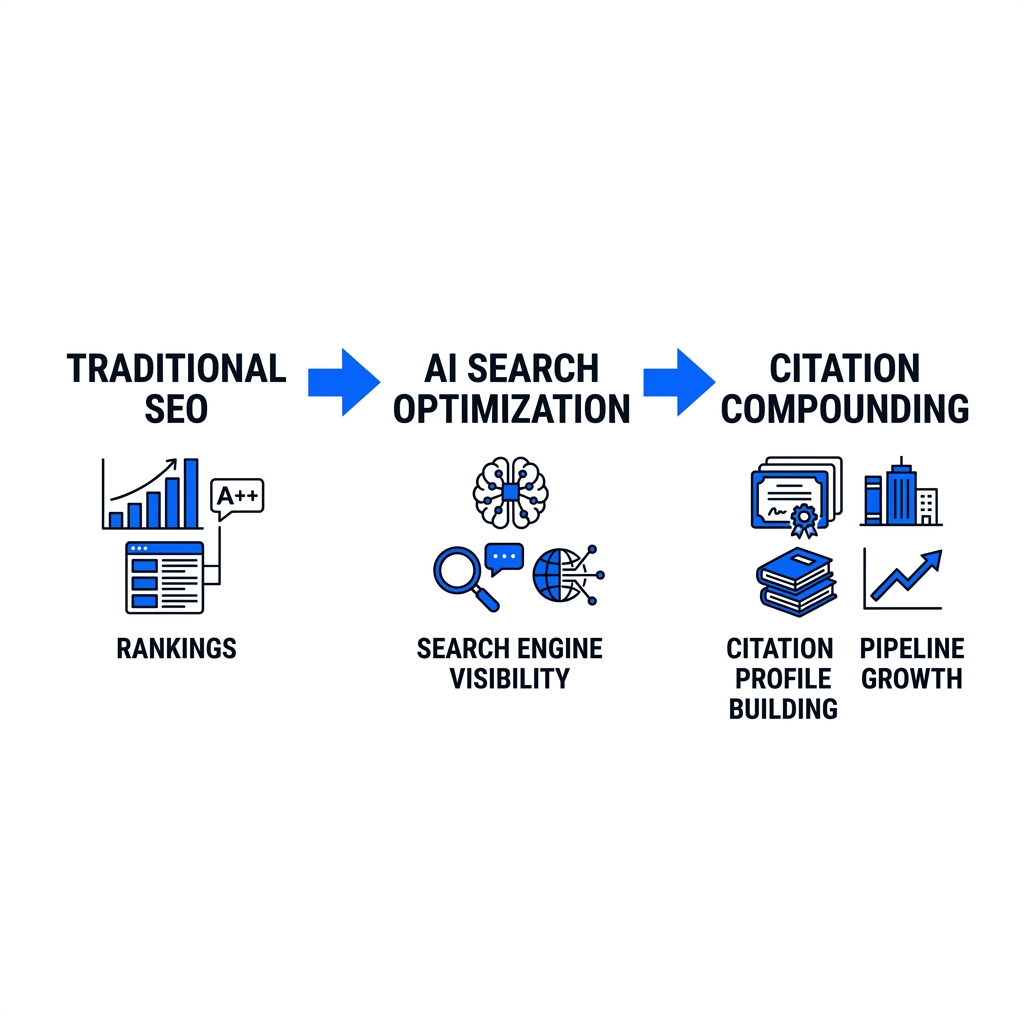
AI search optimization is no longer a future consideration for B2B SaaS companies. It is a present-tense revenue problem. When a buyer asks ChatGPT, Perplexity, or Gemini which project management tool handles enterprise compliance best, the AI returns a short list of recommendations, and if your brand is not on it, you never entered the evaluation. The shift from ranking on a search results page to being cited inside an AI-generated answer changes what "visibility" means for pipeline growth. Competitors who earn those citations today compound their advantage every week, while absent brands lose ground they cannot recover by simply writing more blog posts. For more, see how B2B SaaS brands get cited by Gemini.
Key Takeaway: B2B SaaS brands must treat answer engine optimization as a distinct, structured discipline, not a byproduct of traditional SEO, because AI citation gaps widen with every month of inaction and directly reduce qualified pipeline.

Why AI Search Visibility Now Outweighs Traditional Rankings
Traditional SEO still drives traffic, but the buying journey for B2B software increasingly starts in an AI answer engine (see an AI strategy that drives B2B SaaS visibility). A prospect typing "best HRIS for mid-market companies" into ChatGPT gets a curated recommendation, not ten blue links. That recommendation carries implicit trust because the model synthesizes dozens of sources into a single, confident answer. For SaaS companies, this means the first point of contact with a buyer may now happen inside a model's output, not on your website.
How AI Engines Select Sources for Recommendations
AI answer engines do not index and rank pages the way Google does. They evaluate content for clarity, specificity, and consensus across multiple sources before synthesizing a response. Understanding how AI engines pick SaaS recommendations is the first step toward earning a spot in those answers. Several factors determine whether your content gets cited:
Structural clarity: Content that uses clean headings, direct definitions, and concise comparisons is easier for models to parse and quote
Third-party validation: Mentions on authoritative review sites, industry publications, and comparison pages carry significant weight because models cross-reference multiple sources
Topical authority: Brands that publish deeply on a focused set of buyer questions build a pattern that AI models recognize as expertise over time
Recency and freshness: AI engines favor content that is current, regularly updated, and reflects the latest product capabilities or market conditions
Answer Engine Optimization vs SEO: The Core Differences
SEO optimizes for a search algorithm that ranks pages in a list. Answer engine optimization targets the model's synthesis process, which selects fragments of trusted content to build a direct answer. The two disciplines share some foundations (site structure, topical depth, authority signals) but diverge on what "winning" looks like. In SEO, a page-one ranking drives clicks. In AEO, a citation inside a synthesized answer drives trust and often a direct sales inquiry. AI search trends confirm that buyers increasingly rely on these synthesized answers rather than clicking through multiple search results.
The table below highlights the operational differences SaaS marketing teams need to internalize when planning their AI discoverability strategy.
Dimension | Traditional SEO | Answer Engine Optimization |
|---|---|---|
Primary goal | Rank pages in search results | Get cited in AI-generated answers |
Success metric | Rankings, organic clicks, traffic | Citations, recommendation frequency, AI referral conversions |
Content format | Long-form, keyword-targeted pages | Reference-grade content: definitions, comparisons, structured data |
Authority signals | Backlinks, domain authority | Third-party mentions, review aggregators, cross-source consensus |
Time to impact | 3 to 6 months for rankings | 30 to 60 days for first citations, compounding over time |
Competitive dynamic | Positions shift with algorithm updates | Early citations compound, making late entry progressively harder |
The critical takeaway is that SEO and AEO are not interchangeable. A page ranking first on Google can still be completely absent from ChatGPT's recommendation. SaaS teams that treat AEO as "just more SEO" will not close the gap between website rankings and AI citations.

The AI Citation Strategy Playbook for B2B SaaS
Knowing that AI search matters is not the bottleneck. Execution is. Most SaaS marketing teams understand the shift but stall on what to actually do differently. The steps below translate the theory into a repeatable, structured process that builds AI trust signals (see AI trust signals behind brand citations) over time rather than chasing one-off mentions.
Build Reference-Grade Content That AI Models Trust
AI models select content that reads like a definitive, neutral source. This means your content needs to function less like a marketing asset and more like a reference document. Start with buyer-question research to identify the exact queries prospects type into ChatGPT and Perplexity when evaluating solutions in your category. Map those questions to content that provides direct, structured answers.
Reference-grade content for AI engines has specific characteristics: it defines terms explicitly, compares options with specifics rather than generalities, uses structured HTML (tables, definition lists, clear heading hierarchies), and avoids promotional language that models learn to deprioritize. A product comparison page that names competitors and provides honest feature-by-feature analysis is far more likely to be cited than a landing page built purely for conversion. Following content optimization strategies for AI search ensures each piece is structured the way models prefer to consume it. Pair this with a consistent publishing cadence, as topical authority compounds when a model encounters your brand answering related questions across multiple pages.
Earn Off-Site Authority Where AI Models Already Look
On-site content alone is not enough. AI answer engines cross-reference what third-party sources say about your brand before including it in a recommendation. This means SaaS companies need a deliberate off-site authority-building program that targets the exact sources AI models weigh most heavily: industry review platforms, comparison directories, relevant publications, and respected niche blogs. Google's AI optimization guide confirms that creating unique, non-commodity content and maintaining a clear technical structure remain the foundation for visibility in AI-generated summaries, even as third-party platforms like G2 and Capterra add further reinforcement of that authority.
Digital PR, guest contributions, and structured listings on platforms like G2 or Capterra contribute to the consensus signal that models rely on. Getting content cited by AI engines requires this dual approach: strong on-site foundations plus off-site validation that confirms your brand's authority in the category. For most SaaS teams already stretched thin on product and growth, this is where a specialized answer engine optimization agency like GoBlinkly delivers the most leverage, handling the end-to-end execution that makes AI-driven content optimization sustainable rather than a one-time experiment.
Conclusion
AI search optimization is not an extension of your existing SEO program. It is a separate discipline with its own inputs, metrics, and compounding dynamics. B2B SaaS companies that invest in reference-grade content, structured buyer-question mapping, and off-site authority building will earn citations that pull high-intent buyers into their pipeline before a competitor's sales team even gets a call. The companies seeing results, including GoBlinkly clients who land first citations within 30 to 60 days, share one trait: they stopped treating ChatGPT SEO as a future initiative and started tracking citation ROI as a core growth metric. The gap between awareness and execution is where pipeline is won or lost, and every month of delay hands that pipeline to whoever moved first.
Frequently Asked Questions (FAQs)
What is AI search optimization for B2B SaaS?
AI search optimization for B2B SaaS is the practice of structuring content, building third-party authority, and targeting buyer-intent queries so that AI answer engines like ChatGPT, Perplexity, and Gemini cite your brand as a trusted recommendation when prospects research solutions in your category.
How does AI citation strategy work?
An AI citation strategy works by identifying the exact questions buyers ask AI engines, creating reference-grade content that directly answers those queries, and earning corroborating mentions on third-party sources that models cross-reference before generating recommendations.
How to get cited in ChatGPT as a SaaS brand?
To get cited in ChatGPT, publish structured, factual content that answers specific buyer questions, ensure your brand appears on trusted review sites and industry publications, and maintain topical consistency so the model recognizes your domain expertise across multiple queries.
How long does it take to get AI citations?
First AI citations typically appear within 30 to 60 days of implementing a structured AEO program, with citation frequency and breadth compounding over subsequent months as on-site and off-site authority signals accumulate.
Answer engine optimization vs SEO: which is better?
Neither replaces the other; SEO drives search traffic and supports the authority signals that AEO depends on, but AEO specifically targets the AI-generated answers where high-intent B2B buyers increasingly make shortlist decisions before ever clicking a search result.
How do AI answer engines select sources?
AI answer engines select sources by evaluating content clarity, structural formatting, topical authority, recency, and cross-source consensus, prioritizing pages and brands that multiple trusted sources independently validate as credible in a given category.
How to measure AI search optimization success?
Measure AEO success by tracking citation frequency across major AI engines for target buyer queries, monitoring AI referral traffic and its conversion rate, and comparing your brand's citation presence against competitors over time using dedicated AI SEO tools (see what B2B SaaS actually needs beyond AI SEO tools).
About the Author
Aiden Cross is the Head of AEO and Organic Growth at GoBlinkly, focused on helping B2B SaaS brands get discovered across Google, ChatGPT, Gemini, and Perplexity. He specializes in building scalable AEO systems that align content, site architecture, and authority signals with how modern answer engines select their sources.