Introduction
AI automation is everywhere in B2B SaaS conversations right now, but most of what gets published reads like a press release for a tool nobody has actually stress-tested. For founders and marketing leaders trying to scale without doubling headcount, the real question is simpler: which AI automation use cases deliver measurable operational or revenue impact today? The answer depends less on which platform you pick and more on where you deploy intelligent automation inside your existing workflows. Most SaaS teams already have the data and processes to benefit; what they lack is a clear framework for separating proven leverage points from expensive experiments that stall after the pilot phase.
Key Takeaway: The B2B SaaS companies seeing real ROI from AI automation are focusing on three areas: customer-facing workflows, content and marketing operations, and internal process orchestration. Start with the use case closest to revenue, measure ruthlessly, and expand from there.

Where AI Automation Delivers Real Results in SaaS
The gap between AI automation that works and AI automation that gets abandoned usually comes down to proximity to revenue. Teams that automate processes directly tied to customer acquisition, retention, or operational cost reduction see returns within weeks. Teams that start with internal experiments disconnected from business outcomes tend to burn budget and enthusiasm simultaneously. According to HubSpot's 2026 B2B marketing research, the most successful SaaS companies treat AI not as a standalone initiative but as a layer applied to go-to-market motions already in play.
Customer-Facing Workflows That Scale
Customer support and onboarding are the two areas where AI-powered automation consistently proves its value in B2B SaaS. AI chatbots trained on product documentation can resolve 40% to 60% of tier-one support tickets without human intervention, freeing support teams to handle complex escalations. Automated onboarding sequences that adapt based on user behavior (which features they activate, where they stall) reduce time-to-value and improve trial-to-paid conversion rates. Here are the AI Automation Use Cases that consistently move the needle on the customer side:
AI-assisted ticket routing: Classifies incoming support requests by urgency, topic, and customer tier, then routes them to the right agent or self-serve resource automatically.
Behavioral onboarding triggers: Sends contextual nudges, tutorials, or check-in emails based on what a new user has or has not done inside the product.
Churn prediction models: Flags accounts showing disengagement patterns so customer success teams can intervene before cancellation.
Automated QBR prep: Pulls usage data, support history, and expansion signals into a pre-built quarterly business review deck for account managers.
Smart knowledge base updates: Identifies gaps in help documentation based on recurring ticket themes and drafts new articles for review.
Content and Marketing Operations
Content production is where most SaaS marketing teams first feel the impact of AI workflow automation. The shift is not about replacing writers with language models. It is about compressing the research, outlining, and distribution steps that consume 60% to 70% of the time a piece of content takes to produce. AI tools can generate first-draft briefs from keyword clusters, repurpose long-form posts into social snippets, and schedule distribution across channels without a human touching a spreadsheet. The teams getting the best results still have a human editor making final calls on quality and accuracy, but the throughput increase is significant: many report publishing two to three times more content per month with the same headcount. Where this matters most is in building a marketing strategy that compounds visibility over time rather than producing one-off campaigns that fade.

Building an AI Automation Strategy That Sticks
Picking the right tools matters, but picking the right sequence matters more. The SaaS companies that stall on AI adoption almost always share the same pattern: they bought a platform before defining the problem it needed to solve. A durable AI Automation Strategy starts with an honest audit of where your team spends time on repetitive, rule-based work that does not require creative judgment. GoBlinkly's strategy audits for B2B SaaS clients consistently show that teams spend 40% or more of their operational hours on tasks that meet this definition, making the initial audit the single most important step before any tool selection. Research from HBR's 2026 analysis of AI's impact on B2B SaaS reinforces that the highest-performing SaaS firms prioritize automation in areas where speed directly correlates with competitive advantage.
Evaluating AI Automation Tools and ROI
The best AI automation platforms for B2B SaaS are not necessarily the ones with the longest feature lists. They are the ones that integrate cleanly with your existing stack, require minimal engineering time to deploy, and produce measurable output within 30 days. For most B2B SaaS teams, the practical choice comes down to two tiers: Zapier and Make handle straightforward workflow triggers between existing tools with minimal setup, while platforms like HubSpot's AI features and Clay add intelligence layers for lead scoring and personalized outreach at scale.
If your priority is connecting existing tools quickly, Zapier is the faster starting point. If your priority is AI-driven sales automation with CRM depth, HubSpot or Clay will deliver more measurable pipeline impact. When evaluating tools, focus on three criteria: native integrations with your CRM and product analytics, the ability to set up workflows without writing custom code, and transparent pricing that scales predictably with usage. Calculating AI automation ROI requires more than comparing subscription cost to hours saved. In GoBlinkly's work with B2B SaaS clients, the automations delivering the fastest payback are almost always in customer-facing workflows: ticket routing and onboarding trigger systems typically return their implementation cost within the first 45 days.
Factor in error reduction (automated processes do not fat-finger data entry), speed-to-execution (a lead scored and routed in seconds versus hours), and the opportunity cost of what your team can now do with recovered time. A common benchmark: if an automation saves a team member five hours per week and that time redirects toward revenue-generating activity, the payback period on most workflow automation software is under 60 days. The difference between AI automation vs traditional automation is that traditional rule-based systems break when inputs vary, while intelligent automation adapts to new patterns without manual reconfiguration.
The Visibility Layer Most Teams Miss
One area where AI automation for business creates compounding returns, and where most SaaS teams are still underinvesting, is discoverability. Automating content production and distribution is only half the equation. The other half is ensuring that content gets surfaced by the platforms buyers actually use to make decisions, including AI answer engines like ChatGPT, Perplexity, and Gemini. This is where SEO automation intersects with a newer discipline: Answer Engine Optimization. A recent analysis of AI search visibility found that brands cited by AI answer engines see significantly higher trust signals and conversion rates from those referrals compared to traditional organic traffic.
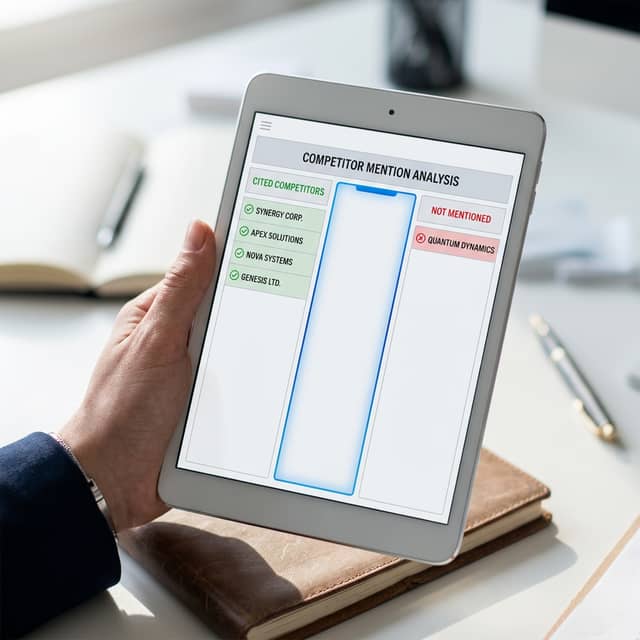
GoBlinkly works with B2B SaaS companies on exactly this problem, ensuring that when buyers ask AI engines who to trust in a given category, the client shows up as a cited recommendation. The approach combines automated workflows for content production with a structured authority-building process designed to earn citations across multiple AI platforms. For SaaS founders already investing in AI automation solutions, adding a visibility layer that compounds month over month is one of the highest-leverage moves available. The growth trends in B2B SaaS point clearly toward AI-driven discovery replacing traditional search as the primary buyer research channel within the next two years.

Conclusion
AI automation works in B2B SaaS when it is deployed against specific, measurable problems close to revenue: customer workflows, content operations, and discoverability.
A B2B SaaS team getting started with AI automation should follow this sequence:
Audit your team's weekly hours to find the top three most repetitive, rule-based tasks.
Map each task to a proximity-to-revenue score: customer acquisition, retention, or cost reduction.
Select one automation tool that integrates with your existing CRM or product analytics without custom engineering.
Deploy on the highest-revenue-proximity task first and measure output within 30 days.
Expand to the next task only after the first automation proves ROI.
The founders seeing real returns are not chasing every new tool; they are sequencing investments based on where time savings translate directly into growth. Start with the process that costs your team the most hours per week, automate it with a tool that integrates cleanly, measure the result within 30 days, and expand from there. Layer in AI-driven visibility through GoBlinkly's AEO approach to ensure the content and authority you build actually gets surfaced where buyers are looking. The companies that treat AI automation as an ongoing operational discipline, not a one-time project, are the ones pulling ahead.
About the Author: David Mercer is Head of AI Search and Content Strategy at GoBlinkly, where he leads AI automation research and content programs for B2B SaaS companies. He specializes in helping founders identify high-ROI automation use cases and build operational systems that scale without proportional headcount growth.
Frequently Asked Questions (FAQs)
What is AI automation?
AI automation uses machine learning and natural language processing to handle tasks that traditionally required human judgment, going beyond simple rule-based triggers to adapt and improve as data patterns change.
How does AI automation work?
It works by training models on historical data to recognize patterns, then applying those patterns to automate decisions like lead scoring, content recommendations, ticket routing, and workflow orchestration in real time.
What are benefits of AI automation?
The primary benefits are reduced operational costs, faster execution speed, fewer manual errors, and the ability to scale processes without proportionally increasing headcount.
Can small businesses use AI automation?
Yes, many no-code and low-code platforms now offer AI automation at price points accessible to small businesses, with some tools starting under $50 per month for basic workflow automation.
What is the difference between automation and AI?
Traditional automation follows fixed rules and breaks when inputs vary, while AI-based automation learns from data and adapts its behavior to handle new scenarios without manual reprogramming.
How much does AI automation cost in the USA?
Costs range from under $100 per month for self-serve workflow tools to $5,000 or more monthly for managed AI automation services, depending on complexity, integration requirements, and the scope of processes being automated.
What AI automation tools are best for B2B SaaS companies in Canada?
Canadian B2B SaaS companies commonly use platforms like Zapier, Make, HubSpot's AI features, and Clay for sales automation, with the best choice depending on existing tech stack integrations and whether the priority is marketing, sales, or operations.