Introduction
For years, B2B SaaS companies have treated website ranking as the definitive measure of online visibility. A top-three position on Google meant qualified traffic, demo requests, and pipeline. But the research behavior of software buyers is shifting fast. Half of B2B software buyers now start their research inside AI chatbots like ChatGPT, Perplexity, and Gemini, not inside a Google search bar. That means the keywords tracked in a rank tracker may only tell half the story, and the other half is playing out in AI-generated responses where a brand may not appear at all.
In short: B2B SaaS companies need to track both Google rankings and AI citations. Rankings measure demand that already exists. Citations measure whether a brand appears before that demand ever reaches a search bar. Tracking only one gives an incomplete picture of how visible a brand actually is.

The Traditional Playbook: What Search Engine Rankings Still Tell You
Google rankings have been the backbone of SaaS growth marketing for over a decade. They remain valuable because they represent real, measurable demand. When a buyer types a high-intent query and a page appears on page one, that is a documented data point tied to traffic, conversions, and revenue attribution. Dismissing keyword ranking entirely would be premature, but understanding where it falls short is essential for any team serious about full-funnel visibility.
What Ranking Performance Metrics Actually Measure
Ranking positions quantify presence in a specific, established system: Google's organic index. They reflect how well a page matches a query based on relevance, authority, and technical optimization. Here is what a best website ranking checker can surface for a SaaS marketing team:
Position tracking: Shows where a page sits for a target keyword on any given day, helping teams spot drops before they affect pipeline.
SERP feature visibility: Identifies whether a site holds featured snippets, People Also Ask boxes, or other enhanced results that drive click-through rate.
Competitive gap analysis: Reveals which competitors outrank a given domain for shared keywords, clarifying where to invest content resources next.
Organic click attribution: Connects ranking positions to actual sessions and conversions, closing the loop between search visibility and revenue.
Where Rankings Stop Reflecting the Full Buyer Journey
The limitation of traditional ranking performance metrics is not accuracy; it is scope. Rankings only measure what happens inside Google's blue-link ecosystem. They cannot reveal whether a buyer asked ChatGPT "What is the best project management tool for mid-market SaaS?" and received a recommendation that excluded a given brand entirely. For B2B SaaS companies selling into long consideration cycles, this gap is widening every quarter. Buyers are forming shortlists before they ever type a keyword into Google, and those shortlists are increasingly shaped by AI answer engines rather than organic search results. This shift is especially pronounced for service businesses that lean on geography, where local rankings alone are no longer enough to capture vendor consideration that increasingly starts inside an AI conversation instead of a city-specific Google search.
The New Signal: Why AI Citation Tracking Matters Now
AI citations represent a fundamentally different kind of visibility. When an AI engine names a product in response to a buyer-intent question, it is not linking to a page. It is recommending that brand as a trusted answer. That distinction changes what teams should measure, how they measure it, and what ranking improvement strategies actually look like in practice.
How AI Answer Engines Decide Who Gets Cited
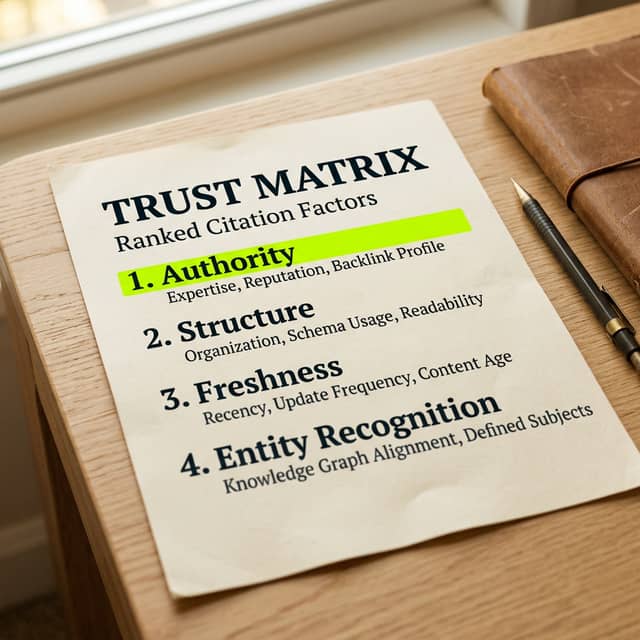
Unlike Google rankings, which are driven by crawlable pages and backlink profiles, AI citations depend on what a model has learned during training and retrieval. AI answer engines choose sources based on a combination of content authority, structural clarity, and recency. If content is well-structured, frequently referenced by credible third-party sources, and organized around specific buyer questions, it has a higher probability of being cited.
This is not a mystery algorithm. It follows identifiable patterns. Models favor content that directly answers questions, provides verifiable claims, and appears consistently across authoritative domains. Companies that invest in Answer Engine Optimization are structuring their digital presence around these signals, ensuring that AI models encounter their brand repeatedly in the right contexts.
What You Lose by Ignoring AI Visibility
The cost of ignoring AI citations is not theoretical. It is competitive displacement that happens silently. A SaaS company can hold position one on Google for a core keyword and still be absent from every AI-generated recommendation in its category. When a VP of Operations asks Perplexity to compare workflow automation tools and a product is missing from the response, that is a lost shortlist placement with zero visibility in any analytics dashboard. Traditional search tools simply cannot detect this gap, which is why companies need to complement their existing SEO strategy with AI visibility tracking.

Building a Measurement Framework That Covers Both
The goal is not to replace one metric with another. It is to build a dual-signal framework where search engine rankings and AI citations (see AI citation generators: do they actually work?) each inform different stages of the funnel. Rankings quantify active search demand. Citations reveal brand trust at the moment of AI-assisted research. Together, they paint a complete picture of how discoverable a SaaS brand really is across every channel a buyer touches.
Mapping Metrics to Funnel Stages
Google rankings are strongest as a mid-funnel metric. By the time a buyer searches "best contract management software pricing," they have already narrowed their consideration set. Ranking well here captures demand that already exists. AI citations, on the other hand, operate at the top of the funnel, during the exploratory phase when buyers are asking open-ended questions and forming initial impressions.
This means a B2B SaaS company tracking only organic ranking growth is measuring demand capture, not demand influence. A company that also monitors how to get content cited by AI engines gains insight into whether its brand is even in the conversation before the Google search happens. The operational implication is straightforward: track both, but assign each metric to the funnel stage it actually represents.
How Canadian SaaS Companies Can Operationalize This
For SaaS companies based in Canada, the dual-tracking approach carries an additional nuance. Local ranking strategies still matter when targeting region-specific queries, especially for companies competing in markets like Montreal or Toronto where buyers search with geographic intent. But AI engines do not operate on local indexes the same way Google does. A query in Perplexity about "best HR software for Canadian companies" pulls from global training data, not a Montreal-specific algorithm.
This is where a partner like GoBlinkly becomes operationally relevant. Specializing in AEO for B2B SaaS, GoBlinkly helps companies bridge the gap between their existing SEO investment and the emerging citation layer. The approach focuses on structuring content, building authority signals, and ensuring that AI models consistently surface the brand for buyer-intent queries. For teams already running SEO alongside AI search strategies, adding a dedicated AEO layer closes the visibility loop that rankings alone leave open.
Practical Steps for Getting Started
Shifting from a ranking-only measurement system to a dual-signal framework does not require rebuilding an entire marketing stack. It requires targeted additions to an existing workflow. Start by auditing current presence across AI answer engines for the top ten buyer-intent queries. Use a combination of manual queries in ChatGPT, Perplexity, and Gemini alongside any AI citation tracking tools available to the team.
Prioritizing the Right Queries
Not every keyword in a rank tracker deserves an AI citation counterpart. Focus on queries where buyer intent is highest: comparison queries, "best of" lists, and problem-solution questions. These are the exact prompts that AI engines receive from buyers evaluating software. If a page ranks well on Google for "best project management tool for agencies" but is absent from the AI response to that same question, that query should be the first AEO priority.
Setting Baselines and Review Cadences
Document AI citation presence today so there is a clear baseline to measure against. Record which buyer queries return the brand, which return competitors, and which return no SaaS brands at all. According to HubSpot, citation visibility can shift within weeks as models update, so a monthly review cadence is the minimum.
Compare this against Google ranking data on the same queries to identify where search presence and AI presence diverge. Those divergence points are the highest-leverage optimization opportunities. When a query shows strong Google ranking but zero AI citation presence, that is the first topic to restructure for answer engine visibility. When a query earns AI citations but low organic ranking, that signals brand trust exists without the traffic to match it, and a content depth investment will close the gap.

Conclusion
Website ranking remains a valuable metric for B2B SaaS companies, but it is no longer sufficient as a standalone indicator of visibility. AI citations now influence how buyers build shortlists, compare options, and form trust, often before they ever reach a search engine. The companies that build measurement frameworks spanning both Google rankings and AI citation tracking will hold a structural advantage over those optimizing for only one channel. Start by auditing AI presence on the highest-value buyer queries, and let the gaps found guide the next investment in content and authority.
GoBlinkly helps B2B SaaS companies get cited by AI answer engines through its fully managed Answer Engine Optimization service.
Frequently Asked Questions (FAQs)
How to check website ranking?
Use a dedicated rank tracker like Ahrefs, SEMrush, or Google Search Console to monitor page positions for specific keywords across search engine results pages.
How often do rankings change?
Google rankings can fluctuate daily due to algorithm updates, competitor content changes, and crawl frequency, though major shifts typically follow core updates or significant site changes.
Is website ranking more important than AI citations?
Neither is universally more important; rankings capture active search demand while AI citations influence the earlier research phase, so tracking both provides the most complete visibility picture.
How does Answer Engine Optimization affect keyword ranking?
AEO does not directly change Google keyword ranking, but the structured content and authority signals it builds often improve traditional SEO performance as a secondary benefit.
Do Canadian SaaS companies need local ranking strategies?
Yes, local ranking strategies help capture region-specific search queries, but they should be paired with AI citation efforts since answer engines pull from global, not geographically indexed, data.