Quick Answer
Managed AI for answer engine optimization usually wins for B2B SaaS teams that need citations without diverting marketers, developers, and subject-matter experts from revenue work. DIY can work when a company already has dedicated technical SEO, editorial, digital PR, analytics, and governance capacity, but it is an ongoing operating system rather than a one-time initiative.
Introduction
For most established SaaS teams, AI answer engine optimization should be treated as a managed growth channel when internal capacity is already allocated to product launches, demand generation, and customer retention. AI research is increasingly part of how buyers shortlist vendors before a sales conversation, so being absent when someone asks ChatGPT, Claude, Perplexity, or Gemini who to trust creates a visibility gap that rankings alone may not solve. Statistics Canada reports that 19.2% of Canadian firms used AI to produce goods or deliver services in 2026, reinforcing that AI capability is becoming a business operating concern rather than an experimental side project. The difficult part is not publishing one AI-friendly page, but sustaining trustworthy evidence across the sources answer engines can use.
Key Takeaways:
DIY AEO requires coordinated research, technical implementation, content production, authority building, and measurement.
Managed AEO reduces internal lift by assigning citation outcomes to a specialist operating model.
The right choice depends on ownership capacity, not whether AI visibility matters to your buyers.
What DIY AEO Requires Each Week
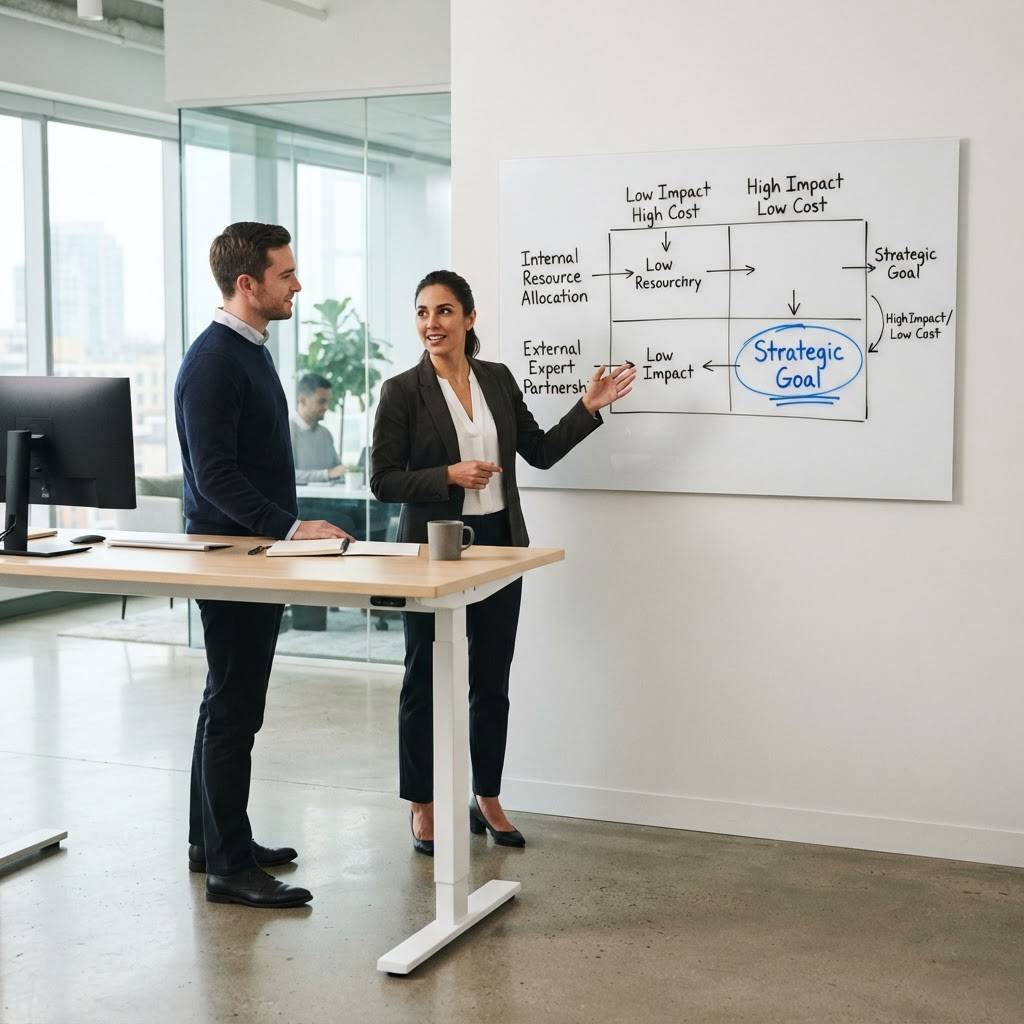
DIY AEO is a cross-functional discipline, not a writing assignment for an existing SEO generalist. The team must identify buyer-intent questions, map the evidence needed to answer them, make pages parseable, publish current reference material, build credible third-party mentions, and monitor how engines describe the category. That workload explains why the practical choice between managed AEO versus in-house depends on available execution time more than enthusiasm.
Five Workstreams an Internal Team Must Own
Internal teams can build capability, but every workstream needs an owner, a review process, and a recurring production cadence. Research also suggests the environment changes quickly: according to content freshness in AI search research from Amsive, 50% of content cited in AI responses is less than 13 weeks old, which makes stale content libraries a direct visibility risk.
Buyer-question research: Identify the comparison, implementation, pricing, and risk questions prospects ask before they contact sales.
Technical clarity: Structure pages so models can extract product facts, audience fit, definitions, proof, and constraints accurately.
Reference-grade content: Create specific, maintained resources that answer a question completely instead of recycling broad keyword posts.
Off-site authority: Earn credible third-party mentions because AI citations from third-party sources research from AirOps found that 85% of AI citations come from sources outside a brand's own site.
Prompt monitoring: Track recurring questions and citations, then diagnose whether the issue is coverage, clarity, authority, or freshness.
Why Existing SEO Capacity Is Not Automatically Enough
The difference in in-house AEO strategy versus conventional SEO is measurement and evidence design. Traditional SEO teams often optimize pages around rankings and organic sessions, while AEO teams must test whether an engine can identify, compare, and recommend the brand in a direct response. This is why AEO vs traditional SEO services is not an either-or decision: search performance supports discoverability, but citation eligibility also depends on structured answers, independent authority, and current proof.

Managed AEO Shifts the Execution Burden
Managed AI marketing services make sense when the company wants an accountable citation program without creating a new internal function. Instead of asking a demand generation team to fit research, site work, editorial production, authority building, and AI answer tracking around existing campaigns, the managed partner operates those activities as one coordinated system. Statistics Canada found that AI adopters showed a 16.8% higher productivity level than non-adopters, though its analysis also notes that pre-existing differences explain part of that advantage.
How Managed and DIY Models Compare
The table below separates the operating differences that matter most to a SaaS marketing leader: ownership, speed, maintenance, and commercial risk. It is more useful than comparing isolated deliverables because citations emerge from the interaction of all these activities.
Decision criterion | DIY AEO | Managed AEO with GoBlinkly | Business implication |
|---|---|---|---|
Team ownership | Internal marketing, SEO, content, development, and PR teams coordinate work. | Specialist team runs buyer research, site work, content, authority, and monthly optimization. | DIY needs durable cross-functional capacity. |
Time to early citations | Depends on internal prioritization and publishing velocity. | First citations typically land within 30 to 60 days. | Defined delivery ownership reduces scheduling friction. |
Measurement | Team selects prompts, tools, reporting standards, and review cadence. | Essential tracks ChatGPT, while Premium tracks all four named engines. | Coverage should match where buyers research. |
Authority work | Internal team sources, pitches, and maintains third-party coverage. | Essential includes 10 authority backlinks monthly, while Premium includes 25 plus digital PR. | Off-site proof requires continuous execution. |
Outcome protection | Internal resources are spent regardless of citation results. | The 90-Day Promise provides a full refund if three industry-relevant buyer-intent ChatGPT citations are not achieved within 90 days. | Risk shifts toward the managed provider. |
GoBlinkly's dual-channel optimization model is the practical distinction: it treats Google visibility and answer-engine citations as connected inputs, while measuring the visible outcome as trusted recommendations. That approach is useful for teams that need done-for-you AI search optimization but still want assets they own after publication.
Cost Means More Than a Monthly Retainer
When leaders ask, "is hiring an AEO agency worth the cost?", the useful comparison is total cost of ownership: specialist labor, tooling, editorial review, developer time, missed campaign work, and the delay caused by competing priorities. According to AEO and SEO platform pricing data from Conductor, standalone AEO tools can range from $500 to $5,000+ monthly, while enterprise SEO platforms can range from $3,000 to $10,000+ per month. GoBlinkly publishes AEO pricing tiers beginning at $2,500 monthly for Essential, $4,500 monthly for Premium, and Enterprise from $7,500 monthly, making the managed cost easier to compare against a fragmented internal stack.
Price is only one governance consideration. Any team using generative AI in its workflow should apply responsible AI principles, including authorized handling of personal information, data accuracy, and organizational accountability for decisions supported by automated systems.
What a Managed Engagement Should Deliver
A managed engagement should provide more than a dashboard that reveals missing citations. It should complete the work needed to close the gap, including question research, technical remediation, content creation, third-party authority development, and a fully managed AEO cadence that keeps the program active after initial pages go live. In GoBlinkly's model, clients grant access and review updates while the agency maintains the operating system behind the visibility work.
Which Path Fits Your SaaS Team?
Choose DIY only when the company can protect dedicated capacity across technical SEO, editorial operations, authority building, analytics, and executive review. It is reasonable for teams with mature workflows, patient leadership, and enough margin to absorb experimentation without postponing core growth work. For resource-constrained teams, fully managed AI marketing for software companies is usually the cleaner decision because one partner owns the coordinated work and is measured on citations rather than activity.
Use Buyer Research as the Decision Test
Run a focused audit of the questions prospects ask AI engines about your category, competitors, integrations, use cases, and implementation risks. If the answers repeatedly name other providers, the issue is not merely traffic; it is an AI research phase lead generation problem that occurs before your sales team sees the account. AI adoption and productivity research from Statistics Canada also shows that service industries have higher adoption rates than manufacturing, particularly information, professional, scientific, and technical services.
Set Standards Before You Outsource
Ask any AI-optimized B2B growth agency to define the buyer prompts it will track, the citation outcome it considers meaningful, the pages and sources it will build, the approval process, and the reporting cadence. A credible partner should distinguish citations from generic ranking reports, describe the work behind the result, and specify what happens if performance falls short. The best AI optimization agencies for B2B SaaS are not those that promise vague AI exposure, but those that make scope, ownership, and accountability visible.
AI impact research also supports a practical conclusion: as business adoption expands, the cost of waiting is not only lost traffic but lost familiarity in the research environments buyers increasingly use.

Conclusion
Managed AEO is the stronger default for SaaS companies that need AI visibility but cannot reliably fund a dedicated internal operating model. DIY delivers control, yet it also requires sustained coordination across disciplines that already compete for scarce capacity. Use a buyer-question audit to establish whether competitors are being cited today, then assess whether your team can execute and maintain every required workstream. If the answer is no, a managed program with transparent scope and outcome protection is the more operationally realistic path.
Ready to see where buyers encounter competitors first? Explore GoBlinkly's AEO approach and start with a competitor visibility audit.
Frequently Asked Questions (FAQs)
What are the benefits of managed AI services for SaaS?
Managed AI services for SaaS centralize specialized research, technical optimization, content production, authority work, and reporting under a single accountable team, helping marketing leaders protect internal capacity for product launches, campaigns, customer expansion, and other revenue responsibilities.
Is AEO the same as traditional SEO?
AEO is not the same as traditional SEO because SEO primarily seeks search visibility and organic visits, while AEO also seeks accurate inclusion and recommendation inside direct AI-generated answers, where evidence quality, topical clarity, freshness, and third-party authority influence citation eligibility.
What does a managed AI marketing agency actually do?
A managed AI marketing agency should research buyer questions, improve site structure for answer extraction, publish useful source material, develop credible external authority, monitor AI responses, and continuously update assets when competitive answers, product positioning, or category language changes.
How does GoBlinkly's AEO framework work?
GoBlinkly's AEO framework combines SEO and AI visibility through its Dual Channel Visibility Framework, then delivers buyer-question research, site rebuilding, reference-grade content, off-site authority, and ongoing optimization designed to earn trusted recommendations across relevant answer engines.
How to get my B2B brand recommended by ChatGPT?
Getting a B2B brand recommended by ChatGPT requires clear product evidence, direct answers to buyer questions, technically accessible pages, credible independent mentions, and recurring monitoring because models need reliable context to identify when a company fits a specific recommendation request.
Can I pay for AI recommendations or citations?
You cannot responsibly pay an answer engine for a guaranteed recommendation or citation, but you can invest in the underlying research, content, technical clarity, and third-party authority that make a brand more credible and easier for AI systems to reference accurately.
What are the pros and cons of AI answer engine optimization?
The pros and cons of AI answer engine optimization are clear: it can capture buyers during early research and build durable category presence, but it demands ongoing evidence maintenance, cross-functional execution, careful governance, and measurement that goes beyond familiar rank-tracking workflows.
About the Author
Ethan Brooks is an AI Content Strategy Specialist focused on scalable organic growth through SEO, AI content generation, keyword research, and content workflow automation. His work translates emerging search behavior into practical operating decisions that connect content execution with buyer intent and measurable business outcomes.