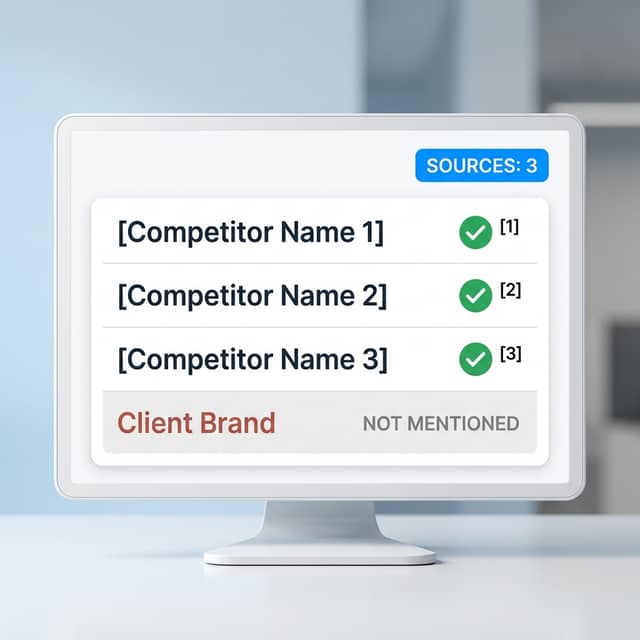
Quick answer: A modern B2B SaaS SEO checklist covers four layers: technical health, on-page precision, content depth, and AI citation readiness, since buyers now research across both Google and AI answer engines simultaneously.
Introduction
A complete SEO checklist is no longer just about ranking on page one of Google. In 2026, B2B SaaS buyers research solutions across traditional search and AI answer engines simultaneously, which means your optimization framework must cover both channels or risk invisible gaps that bleed pipeline. The challenge for most SaaS teams is not a lack of effort but a lack of structure: scattered audits, missed technical foundations, and zero consideration for how AI models parse and cite content. This SEO optimization checklist breaks down every category of work, from technical infrastructure to answer engine readiness, into items you can audit or delegate today.
Key Takeaway: A modern B2B SaaS SEO checklist must cover four distinct layers: technical health, on-page precision, content depth, and AI citation readiness. Addressing all four in a repeatable cycle is what separates compounding visibility from stalled traffic.
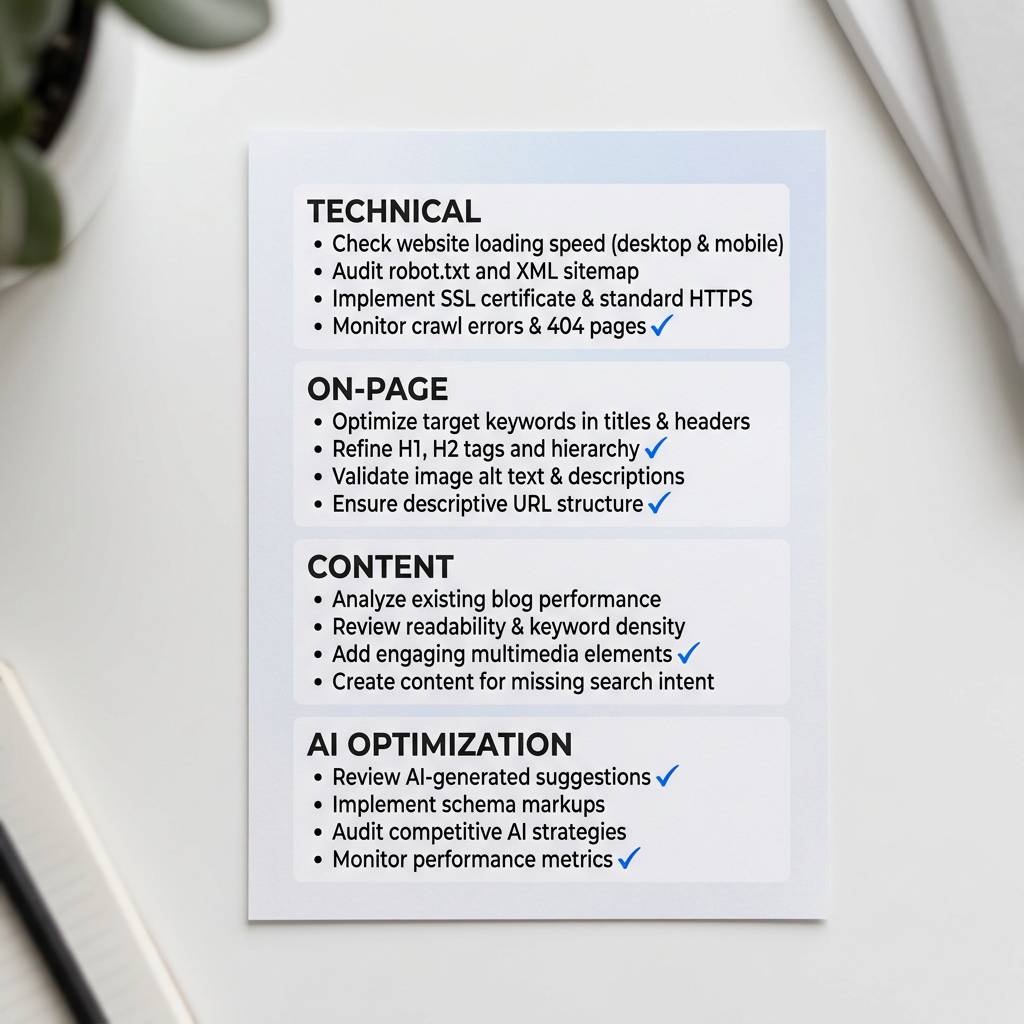
Technical SEO: The Foundation Every Checklist Starts With
Technical SEO determines whether search engines and AI crawlers can access, render, and understand your site at all. If your technical foundation is broken, no amount of content or link building will compensate. A technical SEO checklist catches the silent issues (broken crawl paths, slow pages, missing structured data) that quietly suppress your visibility across every channel.
Core Technical Items to Audit
These are the non-negotiable items every B2B SaaS site should verify at least quarterly. Each one directly affects whether Google indexes your pages correctly and whether AI models can extract clean, structured information from your content. Run through these before touching anything else on your SEO audit checklist.
Crawlability and indexing: Confirm robots.txt does not block key pages, submit an updated XML sitemap, and verify Google indexing status in Search Console for all priority URLs.
Core Web Vitals: Largest Contentful Paint under 2.5 seconds, Interaction to Next Paint under 200 milliseconds, and Cumulative Layout Shift below 0.1, measured on real user data from CrUX.
HTTPS and security: Every page must load over HTTPS with no mixed content warnings, valid certificates, and proper canonical tags to prevent duplicate indexing.
Structured data markup: Implement FAQ, HowTo, Organization, and Article schema where relevant so both Google and AI parsers can extract entities and answers cleanly.
Mobile usability: Google's indexing is mobile-first, so responsive design, tap targets, and viewport configuration must pass without errors.
Technical SEO vs. On-Page SEO: Where to Draw the Line
A common mistake is conflating technical SEO and on-page SEO into a single task. Technical work focuses on infrastructure: server response codes, crawl budget allocation, site architecture, and rendering. On-page work focuses on content-level signals: title tags, header hierarchy, keyword placement, and internal linking. Both are essential, but they require different skill sets and different cadences. Technical audits should happen monthly or after any significant site change. On-page checks should accompany every new page published and every quarterly content refresh.

On-Page, Content, and AI Optimization: The Full Picture
Once your technical house is in order, the next three layers of a website SEO checklist determine whether your pages actually earn clicks, build authority, and get cited by AI answer engines. Each layer compounds on the last: on-page precision makes content discoverable, strong content builds topical authority, and AI optimization ensures that authority translates into citations across AI models.
On-Page and Content Optimization Side by Side
B2B SaaS teams often ask whether to prioritize on-page fixes or new content production. The honest answer is that they serve different functions and should run in parallel. The table below compares the core focus, typical cadence, and impact area of each so you can allocate resources more effectively.
Dimension | On-Page SEO Checklist | Content SEO Checklist | Answer Engine Optimization |
|---|---|---|---|
Primary Focus | Title tags, meta descriptions, header hierarchy, internal links | Topical depth, keyword research coverage, content freshness | Structured answers, entity clarity, citation-worthy authority signals |
Cadence | Every new page + quarterly refresh | Monthly publishing calendar + quarterly gap analysis | Ongoing monitoring across ChatGPT, Gemini, Perplexity |
Impact Channel | Google organic rankings | Google rankings + domain authority | AI answer citations + referral traffic |
Key Metric | Click-through rate, keyword position | Organic sessions, topical coverage % | Citation count, AI referral conversion rate |
Common Gap | Stale meta tags, missing H2/H3 structure | Thin content, no topic cluster architecture | No structured data, no direct-answer formatting |
The clearest takeaway from this comparison is that answer engine optimization is now a distinct discipline, not a byproduct of good SEO. Teams that only check the first two columns leave the fastest-growing discovery channel (AI search) entirely to competitors. According to recent AI SEO statistics from Search Engine Land, AI referral traffic increased 527% in a five-month study period, making this gap more expensive every month you wait.
The AI Optimization Layer Most Checklists Miss
Traditional SEO best practices remain critical, but they were designed for a world where Google was the only gatekeeper. AI models like ChatGPT and Perplexity choose which brands to cite based on different signals: structured, direct answers to buyer-intent questions; consistent entity information across trusted third-party sources; and reference-grade content that reads as authoritative rather than promotional. Your answer engine optimization checklist should verify that every key landing page includes a clear, structured answer to at least one high-intent buyer question, that your brand's entity data (name, category, differentiators) is consistent across directories and publications, and that your off-site authority footprint appears on the sources AI models already trust.
This is where GoBlinkly's Dual Channel Visibility Framework becomes relevant. Rather than treating Google SEO and AI citation as separate strategies, the framework treats strong on-page and technical SEO as the substrate that feeds AI discoverability. Building on-page SEO best practices into every page ensures that the same content ranks in traditional search and gets parsed cleanly by answer engines. A well-structured step-by-step SEO framework should now include both channels by default.

Conclusion
The difference between a checklist that works and one that gathers dust is whether it accounts for how search actually works in 2026: dual-channel, AI-informed, and compounding. Start with technical health, layer in on-page and content optimization, and build the AI citation readiness that most competitors still ignore. Run this checklist quarterly, delegate the execution if capacity is tight, and measure progress not just in rankings but in whether AI models name your brand when buyers ask who to trust. For B2B SaaS teams ready to close the gap, GoBlinkly's dual-channel SEO checklist provides a deeper operational breakdown of every item covered here.
Frequently Asked Questions (FAQs)
What should be included in an SEO checklist?
A thorough SEO checklist should include technical infrastructure checks (crawlability, Core Web Vitals, HTTPS), on-page optimization (titles, headers, internal links), content depth audits, and an AI citation readiness layer covering structured data and entity consistency.
How often should you run an SEO audit?
Run a full SEO audit quarterly, with lighter technical checks monthly and on-page reviews every time a new page is published or an existing page is refreshed.
What is the difference between an SEO checklist and an SEO audit?
An SEO checklist is a repeatable framework of items to verify proactively, while an SEO audit is a deeper diagnostic investigation that identifies root causes behind performance issues and prioritizes fixes by impact.
Is a DIY SEO checklist enough for B2B SaaS?
A DIY checklist works well for technical hygiene and on-page optimization fundamentals, but most B2B SaaS companies need agency-level content and authority execution for sustained content production, off-site authority building, and AI citation optimization at scale.
What is a technical SEO checklist?
A technical SEO checklist covers server-side and infrastructure items like crawlability, indexing status, site speed, HTTPS configuration, structured data, and mobile usability that determine whether search engines can access and understand your pages.
Can an SEO checklist improve AI search visibility?
Yes, when the checklist includes AI-specific items like structured answer formatting, entity consistency across third-party sources, and schema markup, it directly improves how answer engines parse, evaluate, and cite your content.
Does an SEO checklist work for Canadian SaaS companies?
The core checklist items (technical, on-page, content, AI optimization) apply equally to Canadian SaaS companies, with additional considerations for bilingual content, local schema markup, and Canada-specific directory listings if serving regional buyers.
About the Author
Aiden Cross is the Head of AEO and Organic Growth at GoBlinkly, focused on helping B2B SaaS brands get discovered across Google, ChatGPT, Gemini, and Perplexity. He specializes in building scalable AEO systems that align content, site architecture, and authority signals with how modern answer engines select their sources.