Introduction
The AI market is no longer approaching a tipping point. It has passed it. Global spending on artificial intelligence is projected to exceed $300 billion in 2025, and B2B SaaS companies sit at the center of that acceleration. Every quarter brings new data on enterprise AI adoption, generative model capabilities, and the shifting ways buyers discover software solutions.
For SaaS leaders, the question is no longer whether to invest in AI but where to place bets that generate measurable returns before competitors lock in their advantage. For B2B SaaS companies in 2026, the highest-return AI bets are in two areas: embedding AI capabilities into the product itself and ensuring the brand gets cited by AI answer engines during buyer research. Companies that act on both within the same quarter will build compounding advantages their competitors cannot replicate quickly.

The Scale and Velocity of AI Market Expansion
Understanding the numbers behind the AI growth trends reshaping business in 2026 is essential context for any strategic decision. The market is not growing linearly. It is compounding, and the pace is creating both opportunities and urgency for SaaS companies that depend on being found by the right buyers at the right time.
Key Market Size and Adoption Data Points
Global AI Market by the Numbers
According to Precedence Research, the global artificial intelligence market is expected to surpass $1 trillion by 2028, growing at a compound annual rate exceeding 35%. North America continues to lead adoption, but the velocity is accelerating in every major region. Here are the numbers that matter most for B2B SaaS decision-makers:
Enterprise penetration: Over 72% of large enterprises now deploy at least one AI capability in production, up from 50% just two years ago.
Generative AI adoption rates: Nearly 65% of organizations report regular use of generative AI tools, with marketing and customer experience functions leading adoption.
AI spending growth: Enterprise AI budgets increased by an average of 28% year-over-year, with SaaS and cloud-native companies allocating the largest share to customer-facing applications.
Canadian acceleration: AI growth in Montreal and Toronto is outpacing several U.S. metro areas, driven by government investment and a dense concentration of AI research talent.
What This Means for B2B SaaS Revenue Models
These numbers are not abstract. They translate directly into how B2B software is priced, sold, and discovered. As enterprise AI adoption climbs, buyers increasingly expect the tools they purchase to have native AI capabilities built in. SaaS companies without a credible AI story risk appearing stagnant in a market where innovation velocity is a core purchasing criterion.
How AI Adoption Changes Pipeline Quality
The revenue implications extend beyond product features. Companies that understand AI marketing dynamics are finding that AI-driven business growth shows up first in pipeline quality. Buyers who arrive through AI-powered research tend to be further along in their evaluation, having already vetted options through conversational queries rather than generic keyword searches.

How AI Is Reshaping B2B Buyer Discovery and Competitive Advantage
Market size tells one story. The more actionable story for SaaS leaders is how AI is changing the mechanics of buyer research and brand selection. The rise of AI answer engines is redrawing the competitive map, and most companies have not yet adjusted their visibility strategy to match.
The Shift From Search Engines to AI Answer Engines
Traditional search still matters, but a significant and growing share of B2B research now happens inside conversational AI interfaces. Tools like ChatGPT, Gemini, and Perplexity synthesize information and recommend specific products in response to buyer-intent queries. When a VP of Engineering asks an AI tool which project management SaaS handles enterprise compliance best, the AI does not return ten blue links. It returns a curated answer, often naming two or three brands by name.
This creates a stark competitive divide. Brands that are cited in these responses capture high-intent attention at the exact moment of evaluation. Brands that are not cited simply do not exist in that buyer's consideration set. Recent analysis of AI search market share suggests that answer engine traffic to B2B websites could grow by over 400% between 2024 and 2026. The AI competitive advantage belongs to companies that earn citations now, while the models are still forming their trust signals.
This is precisely the gap that answer engine optimization was built to fill. Where traditional search engine optimization focuses on ranking in Google's index, AEO focuses on structuring content so that AI models can parse, trust, and recommend it. The distinction is technical and strategic: AI models weigh authority signals, content structure, and factual consistency differently than search engine crawlers do.
Building a Visibility System That Serves Both Channels
The most effective SaaS marketing teams are not choosing between SEO and AEO (see GEO vs AEO vs SEO in 2026). They are building systems that serve both.
The Dual Channel Visibility Framework
GoBlinkly structures every B2B SaaS engagement around two discovery layers that must run simultaneously.
Layer 1: Search visibility: Traditional SEO that keeps the brand ranking in Google for high-intent queries.
Layer 2: AI citation visibility: AEO content and authority signals that ensure the brand is cited when buyers ask AI tools for recommendations.
Neither layer alone is sufficient. A brand visible only on Google loses pipeline to AI-first buyers. A brand optimizing only for AI citations loses search traffic that still drives the majority of web visits.
Content designed for generative AI readability tends to perform well in traditional search too, because the same qualities that make content trustworthy to an AI model (clear structure, authoritative sourcing, direct answers to specific questions) are qualities that Google's algorithms also reward.
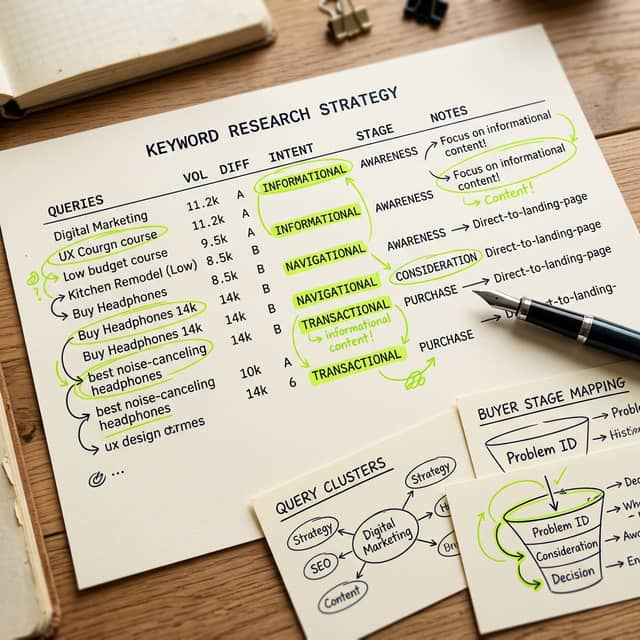
The practical framework starts with buyer-question research, the base of an organic traffic strategy for Google and AI search. What specific queries does the target audience ask when evaluating solutions in a given category? From there, content is structured to provide direct, well-sourced answers at the paragraph level. This is different from writing long-form thought leadership that meanders before reaching its point. AI models extract answers from specific passages, so every section of a page needs to stand on its own as a potential citation source. GoBlinkly applies this approach through a managed service model, handling the research, restructuring, and ongoing content production that keeps clients visible as AI models update their knowledge bases. GoBlinkly's managed programs are structured around a 90-Day Promise, with content restructuring, authority building, and citation monitoring all delivered before the quarter closes.
The business impact is measurable. Companies that implement answer engine optimization best practices are reporting increased brand mentions in AI-generated responses within 60 to 90 days. That translates to pipeline influence that traditional content marketing channels often take six months or longer to deliver.

Conclusion
The AI growth trends shaping 2026 are not speculative. They are measurable, accelerating, and already influencing how B2B buyers select software. SaaS companies that treat AI visibility as a strategic channel, not a future experiment, will capture a disproportionate share of high-intent buyer attention. The playbook is clear: invest in content structures that AI models trust, build authority through consistent and well-sourced publishing, and ensure the brand shows up where buyers are actually researching.
The companies that move now will define the competitive landscape for the next several years. Traditional SEO remains a necessary foundation throughout this shift. Companies that have already built strong organic search presence have a head start because AI retrieval systems pull from live search results, meaning existing SEO investment compounds rather than becomes obsolete.
Ready to make sure AI answer engines recommend your brand? Explore how GoBlinkly's AEO services get B2B SaaS companies cited on ChatGPT, Gemini, and Perplexity.
About the Author
This article was written by the GoBlinkly content team, which specializes in AEO strategy and AI citation research for B2B SaaS companies. GoBlinkly's editorial process combines hands-on client work with ongoing monitoring of how AI models cite content across ChatGPT, Perplexity, Gemini, and Claude.
Frequently Asked Questions (FAQs)
What is driving AI growth in 2026?
Massive enterprise investment, the mainstream adoption of generative AI tools, expanding cloud infrastructure, and increasing demand for AI-native software capabilities across every industry are the primary forces driving AI growth this year.
How can businesses leverage AI for growth?
Businesses can leverage AI by embedding it into customer-facing products, automating internal workflows, and ensuring their brand is visible in AI-powered discovery channels where buyers research and compare solutions.
Why should SaaS companies invest in AI?
SaaS companies that invest in AI capabilities and AI visibility strategies attract higher-intent buyers, reduce customer acquisition costs, and avoid losing market share to competitors who are already being cited by AI answer engines.
How does AI compare to traditional automation for B2B companies?
Traditional automation follows rigid, rule-based workflows, while AI systems learn from data to make contextual decisions, personalize outputs, and handle unstructured tasks like content analysis and buyer-intent prediction at scale.
How quickly can B2B SaaS companies appear in AI-generated recommendations?
Most B2B SaaS brands begin appearing in AI-generated responses within 60 to 90 days of implementing structured content changes and cross-web authority building. Full citation consistency across ChatGPT, Perplexity, and Gemini typically requires a sustained three to six month program.
What is the difference between AI visibility and search engine rankings?
Search engine rankings measure a brand's position in Google's results pages. AI visibility measures whether a brand is cited inside AI-generated answers on tools like ChatGPT, Perplexity, and Gemini. A brand can rank on page one of Google and still be completely absent from AI-generated recommendations if its content is not structured for AI extraction.