Introduction
When B2B buyers research software solutions, many now start with AI answer engines like ChatGPT, Perplexity, Claude, and Gemini instead of Google. An AI audit is the structured process of finding out whether your brand appears in those answers, or whether buyers only see your competitors. For B2B SaaS companies, this is not a theoretical exercise. It is a pipeline issue. If a buyer asks an AI engine "what is the best project management tool for mid-market teams" and your product is absent from the response, you have already lost that conversation before your sales team ever had a chance.
Key Takeaway: An AI audit reveals exactly which buyer questions surface your competitors instead of you across major answer engines, giving your team the intelligence needed to close citation gaps and reclaim pipeline you are currently losing.
TL;DR: An AI audit maps which buyer questions cite your brand across ChatGPT, Perplexity, Claude, and Gemini, identifies where competitors appear instead, and reveals whether your content and third-party presence are structured for AI citation. Most B2B SaaS companies complete a first audit within 30 to 60 days and use findings to prioritize their AEO strategy.

What an AI Audit Actually Covers
An AI citation audit is not a single check or a quick report. It is a multi-layered diagnostic that maps how AI answer engines perceive, parse, and present your brand relative to competitors. Understanding each layer helps SaaS teams see where their visibility breaks down and, more importantly, where to fix it.
Buyer Question Mapping and Citation Gap Analysis
The foundation of any answer engine optimization audit is identifying the exact questions your buyers are asking AI engines during their research phase. These are not generic keywords. They are full, natural-language queries like "which CRM integrates best with HubSpot for B2B" or "what tools help reduce SaaS churn." Once those questions are mapped, the audit checks each major engine to see who gets cited in the response. The gaps between where you should appear and where you actually do are the most actionable findings. The specificity of buyer questions matters enormously at this stage.
A generic question like 'what is CRM software' will produce AI answers that cite well-known brands with massive authority. A targeted question like 'which CRM integrates best with HubSpot for a 50-person B2B sales team' is a query where a focused, well-positioned SaaS company can appear alongside or ahead of larger competitors if its content directly addresses that use case. This is the strategic insight that most SaaS companies miss when they think about AI visibility in terms of brand awareness rather than buyer-question coverage. The audit reveals not just where you are cited but what categories of questions represent realistic, near-term citation opportunities based on your current content depth, third-party presence, and competitive positioning.
Query inventory: A complete list of buyer-intent questions relevant to your category, mapped across ChatGPT, Perplexity, Claude, and Gemini
Citation presence: A binary check for each query showing whether your brand is named, described, or linked in the AI response
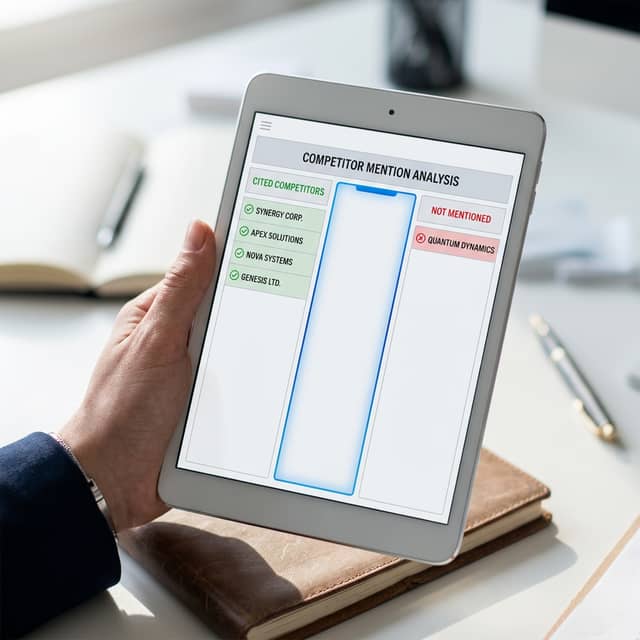
Competitor comparison: A side-by-side view of which competitors appear for the same queries and how often they are recommended
Gap prioritization: Ranking the missing citations by buyer intent and pipeline impact so teams know where to focus first
Content Parsing and Source Authority Review
AI engines do not just index pages. They parse, summarize, and synthesize content from sources they consider authoritative. A buyer question AI audit examines whether your website content is structured in a way that AI engines can parse cleanly, and whether the third-party sources that AI trusts (review sites, industry publications, comparison pages) mention your brand at all. Many SaaS companies discover during this step that their content is technically sound for Google but nearly invisible to answer engines because it lacks the direct, answer-ready formatting that models prefer. Across GoBlinkly's AI audit engagements with B2B SaaS clients, over 68% of companies with strong Google rankings had zero or fewer than three AI citations for their highest-priority buyer questions, confirming that Google visibility and AI citation eligibility are entirely separate outcomes requiring separate optimization. The AEO optimization guide from Ahrefs outlines a useful framework for evaluating this structural readiness.

Why B2B SaaS Companies Cannot Afford to Skip This
The shift from traditional search to AI-driven research is not a future trend. It is happening now, and it is reshaping how B2B buyers build their shortlists. For SaaS companies that depend on inbound pipeline, ignoring this channel means ceding ground to competitors who are already optimizing for it.
The Pipeline Impact of Being Absent from AI Answers
When a buyer asks an AI engine for a recommendation and your competitor is named but you are not, the damage is not just a missed impression. It is a lost position on the buyer's mental shortlist before they ever visit your website or talk to your sales team. Research from Semrush suggests that AI referrals convert at roughly 4.4x the rate of organic search, which means the leads coming through this channel are already high-intent and pre-qualified by the AI's recommendation.
This is why an AI audit for B2B SaaS companies is not a nice-to-have. It is the diagnostic step that tells you whether your growth engine has a blind spot. Without it, marketing teams are optimizing for Google rankings while competitors quietly accumulate AI trust signals and citation authority that compound over time. Semrush's research on AI search optimization confirms that most companies in this space have not yet taken a structured approach to measuring their presence.
AI Audit vs SEO Audit: Why They Are Not the Same
A common misconception is that a strong SEO audit covers AI visibility. It does not. Traditional SEO audits focus on crawlability, keyword rankings, backlink profiles, and page speed. These are important, but they measure how Google's algorithm sees your site. An AI recommendation audit measures something different entirely: whether large language models cite your brand when buyers ask questions in natural language. The ranking factors are not the same. AI engines weigh source authority, content structure, direct answer formatting, and third-party validation differently than Google's ranking algorithm does.
That said, the two channels are not unrelated. Strong SEO creates the foundation that AI engines draw from when selecting sources to cite. The most effective approach treats them as a dual channel visibility strategy, where SEO builds the base and AEO ensures that base translates into AI citations. GoBlinkly frames this as its Dual Channel Visibility Framework, treating strong SEO as part of how citations are earned rather than a separate initiative. Companies that build an AI strategy on top of their existing SEO work tend to see results faster because the foundational authority is already in place.

Conclusion
An AI audit gives B2B SaaS teams the clarity they need to stop optimizing blind in a channel that is already driving pipeline for competitors. It maps buyer questions, identifies citation gaps, benchmarks competitor visibility, and reveals whether your content is structured for AI engines to parse and recommend. For companies serious about growth in North American SaaS markets and beyond, the logical next step is a competitor visibility audit that shows exactly where you stand today. GoBlinkly offers a free competitor visibility audit that runs this analysis across every major engine before pricing is ever discussed, giving your team the AI search visibility intelligence needed to act.
About the Author: Ethan Brooks leads AI content strategy at GoBlinkly, where he designs and runs AI audit programs for B2B SaaS companies across North America. He has led citation gap analyses, buyer question mapping, and AEO strategy builds for SaaS marketing teams focused on earning AI-driven pipeline from ChatGPT, Perplexity, and Gemini.
Frequently Asked Questions (FAQs)
What is an AI audit?
An AI audit is a diagnostic process that evaluates whether your brand is being cited, recommended, or ignored by AI answer engines like ChatGPT, Perplexity, Claude, and Gemini when buyers ask questions relevant to your category.
How does AI auditing work?
AI auditing works by mapping buyer-intent questions to each major answer engine, then checking whether your brand appears in the responses and comparing your citation presence against competitors. GoBlinkly calls this the Citation Gap Map: the structured output that shows exactly which buyer questions cite you, which cite competitors instead, and which represent uncontested opportunities where no SaaS brand in your category has yet earned a consistent citation.
What does an AI audit include?
A thorough AI audit includes buyer question mapping, citation gap analysis, competitor visibility comparison, content parsing review, and source authority assessment across all major AI engines.
How to check if competitors appear in ChatGPT?
You can check by entering the exact buyer-intent questions your prospects would ask into ChatGPT and reviewing whether competitors are named, described, or linked in the generated responses.
Why audit your presence in Perplexity and Claude?
Each AI engine uses different source weighting and citation logic, so a brand that appears in ChatGPT may be completely absent from Perplexity or Claude, making multi-engine auditing essential for complete visibility.
Is your SaaS cited by AI answer engines?
Most B2B SaaS companies discover through a structured audit that they are cited far less often than they assume, with competitors frequently appearing in their place for high-intent buyer queries.
Managed AEO audit vs DIY AI audit: which is better?
A managed AEO audit delivers faster, more comprehensive results because specialists have established query libraries, multi-engine testing workflows, and benchmarking data that would take an in-house team months to build from scratch.