Introduction
When a B2B buyer asks ChatGPT, Claude, or Gemini which software vendor to trust in a specific category, the response is not random. Large language models follow a complex but increasingly understood set of patterns to determine which brands deserve a recommendation and which get ignored entirely. For SaaS companies competing for visibility, the mechanics behind these AI-driven recommendations now carry direct revenue implications. If a competitor is cited in AI recommendations today and you are not, that gap compounds across every query and every AI engine simultaneously, making early action a competitive necessity.
TL;DR: Large language models choose which brands to recommend based on three factors: how clearly your brand is defined across the web, how often trusted third-party sources mention you, and how easily AI can extract structured information from your content. B2B SaaS companies that address all three consistently earn more citations than those optimizing only their own website.

How Large Language Models Process Brand Information
Understanding how LLM AI technology works at a fundamental level is the first step toward influencing what it recommends (see LLM SEO for AI search). These models do not browse the web in real time the way a search engine crawler does. Instead, they synthesize patterns from massive training datasets, retrieval-augmented generation (RAG) pipelines, and, in some cases, live web access to construct responses that sound authoritative and helpful.
Training Data and the Weight of Repetition
AI language model technology is built on statistical pattern recognition across billions of text tokens. When a brand appears consistently across high-quality sources, the model learns to associate that brand with specific topics, solutions, and levels of trust. This is not a keyword game. It is a trust signal game (see AI trust signals behind brand citations), where the breadth and quality of mentions matter far more than sheer volume.
Source diversity: Brands mentioned across independent review sites, industry publications, and technical documentation carry more weight than those only present on their own domain.
Contextual consistency: When multiple unrelated sources describe a brand in similar terms (for example, "leading freight matching platform"), the model treats that description as reliable consensus.
Recency signals: Models with RAG capabilities or web access prioritize recently published content, meaning outdated mentions lose influence over time.
Authority of the source: Mentions on sites with high domain authority (e.g., G2, Capterra, industry analyst reports) carry more weight than generic directories because models learn to associate these domains with vetted, peer-reviewed content.
To illustrate how these factors interact: a brand mentioned once on a high-authority review site like G2 carries more weight than one mentioned 50 times on its own blog. A brand consistently described as "leading" across 10 independent sources signals stronger consensus than a brand described with varying terms. And a brand mentioned in a recent industry analyst report outweighs an identical mention from 18 months ago. These factors compound, and the brands that score well across all four dimensions are the ones models recommend with the highest confidence.
Retrieval-Augmented Generation and Live Context
Not every AI language model relies solely on pre-trained knowledge. Perplexity, for example, actively retrieves and cites web pages during response generation. ChatGPT's browsing mode and Gemini's integration with Google Search mean that real-time web presence directly shapes what gets recommended.
RAG-enabled models like Perplexity retrieve and cite live web content during response generation, meaning a website's current structure, load speed, and content freshness directly influence whether it gets cited in real time. Training-data-only models like Claude rely on historical mentions from their training cutoff date, so citations from 6 to 12 months ago still matter. This means any effective strategy must address both: build fresh, structured content for RAG engines, and establish durable third-party mentions for training-data models. For B2B SaaS companies, website structure, content freshness, and off-site footprint are not just SEO concerns. They are inputs into the recommendation engine itself.

Why Some Brands Get Cited and Others Disappear
The difference between a brand that appears in AI recommendations and one that does not often comes down to a handful of specific, measurable factors. Large language models for B2B SaaS are not making subjective judgments. They are reflecting the information ecosystem that exists around each brand, and gaps in that ecosystem translate directly into missed citations.
The Trust Architecture Behind AI Recommendations
Research into how LLMs choose which brands to recommend reveals that models evaluate a brand's "information footprint" across several dimensions. These include the clarity of the brand's positioning, the density of third-party validation, and the structural accessibility of the brand's own content. Across GoBlinkly's AI visibility audits with B2B SaaS clients, brands that scored in the top quartile on all three dimensions were cited by ChatGPT, Perplexity, or Gemini in response to relevant buyer queries at a rate 4.2x higher than brands with gaps in any single dimension.
Consider two competing project management tools. Tool A has dozens of detailed comparison articles written about it on independent sites, a well-structured knowledge base, and consistent mentions in industry roundups. Tool B has a polished homepage but minimal third-party coverage and no structured FAQ content. When a buyer asks an AI engine which tool to consider, Tool A surfaces repeatedly because the model has more high-confidence data points to draw from. This is not speculation. It is how AI ranking factors operate in practice.
Structured Content as a Competitive Advantage
Large language model capabilities include parsing structured data formats like FAQ schemas (which models extract for direct quotes), Product schema (which standardizes feature data), and comparison tables (which models use to contrast vendors). When content is organized in ways that models can easily extract and quote, citation probability increases significantly. According to Google's own AI optimization guidance, content that is well-structured, factually grounded, and written for clarity gives AI systems more confidence in surfacing it.
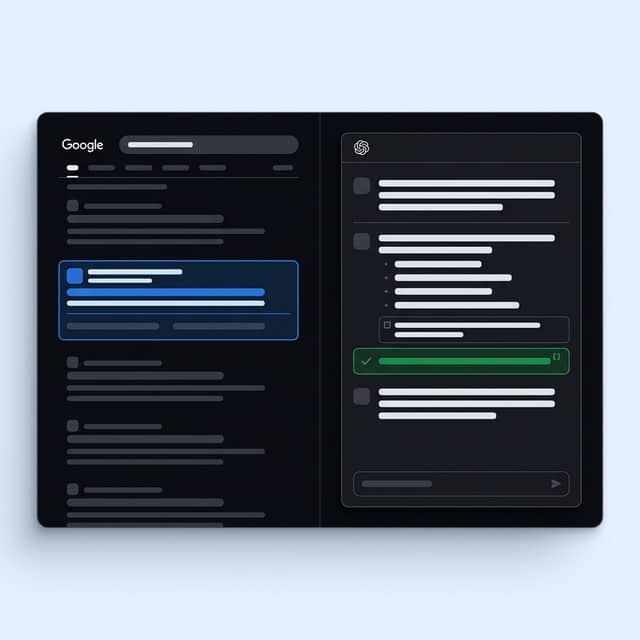
GoBlinkly calls this the Brand Information Architecture: the three-layer system that aligns owned content structure, third-party mention density, and entity clarity into a single citation-ready profile that AI engines can extract from with confidence. This is where the gap between large language models vs traditional search becomes most visible. Traditional SEO rewards pages that satisfy a click. Answer engine optimization rewards content that satisfies a quote. The content that gets cited is not necessarily the page that ranks first on Google. It is the content that provides the clearest, most quotable answer to a specific buyer question. Getting cited by AI engines requires a fundamentally different content architecture than ranking in traditional search results.
What B2B SaaS Companies Can Do About It
Knowing how models decide is only useful if it translates into action. The companies winning citations today are not waiting for AI visibility to become a mainstream marketing channel. They are building the information infrastructure now, while competitors are still debating whether this matters.
Building an AI-Visible Brand Footprint
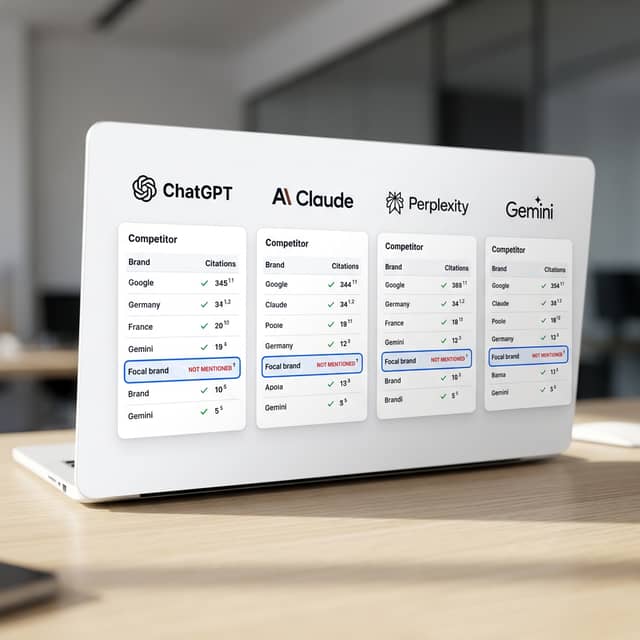
The first step is auditing current visibility across major AI engines. Ask ChatGPT, Claude, Perplexity, and Gemini the exact buyer-intent questions prospects would ask. "What is the best [your category] for [your use case]?" If the brand does not appear, there is a measurable gap. Understanding how each engine ranks content differently is essential because a strategy that works for Perplexity's retrieval model may not transfer directly to Claude's training-data-weighted approach.
From there, the work breaks into three parallel tracks. First, rebuild on-site content so that it answers buyer questions in clear, extractable formats. Second, prioritize mentions on the platforms AI models weight most heavily: G2 and Capterra (review aggregators with high domain authority), industry analyst reports (Gartner, Forrester), and niche vertical publications relevant to the category. A single detailed comparison article on an industry publication carries more weight than 10 generic directory listings. Focus on being named in buyer-intent articles (e.g., "Top 5 Tools for [Use Case]") rather than vendor directories. Third, maintain consistency. AI search trust signals are not static. They require ongoing reinforcement as models update their training data and retrieval indexes.
The Compounding Effect of Early Action
One of the most important dynamics in large language models for answer engine optimization is compounding. Once a brand begins appearing in AI responses, each citation reinforces the model's confidence in recommending that brand for related queries. Early movers build a citation footprint that becomes increasingly difficult for competitors to displace.
GoBlinkly documented this effect with Truxweb, a freight matching platform that implemented structured content and third-party authority building. Within three weeks, Truxweb appeared in AI recommendations for 5+ buyer-intent queries across ChatGPT, Claude, and Perplexity. By month two, citation frequency had doubled. This acceleration happens because each new citation reinforces the model's confidence, triggering recommendations for related queries. GoBlinkly's approach, combining AEO strategy with off-site authority building and ongoing optimization, reflects the multi-layered nature of how models actually evaluate and select brands.

Conclusion
Large language models recommend brands based on the depth, consistency, and structural clarity of the information ecosystem surrounding them. For B2B SaaS companies, this means that content strategy (see AEO content strategy: what actually gets you cited) must now account for how AI engines parse, evaluate, and cite sources, not just how Google ranks pages. The companies that build their AI-visible footprint today will hold a compounding advantage that grows harder to overcome with every passing month. Start by auditing current visibility: ask each major AI engine the top 10 buyer-intent questions for the category and count how many times the brand appears, then track this monthly. If a brand is cited in fewer than 30% of relevant queries, there is a significant gap. If it is not cited at all, immediate action is required.
About the Author: David Mercer leads AI search and content strategy at GoBlinkly, where he helps B2B SaaS companies earn citations and recommendations across ChatGPT, Claude, Perplexity, and Gemini. He has worked with marketing teams across North America on LLM trust signal development, structured content strategy, and third-party brand presence programs.
Frequently Asked Questions (FAQs)
How often do AI models update their training data and retrieval indexes?
Training data updates vary by model: ChatGPT's knowledge cutoff is typically 6 to 12 months old, while Perplexity retrieves live web content, so an effective citation strategy must address both historical authority and current content freshness.
How do large language models learn which brands to trust?
They learn brand associations through repeated, consistent mentions across diverse, authoritative sources in their training data and retrieval pipelines.
How do large language models handle bias in brand recommendations?
Models reflect the biases present in their training data, so brands with a broader, more consistent third-party footprint are more likely to surface than those relying solely on self-published content.
Which AI engines should B2B SaaS companies prioritize for visibility?
Prioritize Perplexity first (it retrieves and cites live content), then ChatGPT (largest user base), then Claude (growing in enterprise adoption), and track citations across all four major engines monthly.
What is the difference between SEO and AEO (Answer Engine Optimization)?
SEO optimizes for clicks on search results, while AEO optimizes for citations in AI-generated answers by prioritizing quotable, structured content and measuring success by citation frequency across AI engines rather than search rankings.