Introduction
AI engines pick which SaaS to recommend by cross-referencing six signals: third-party mentions, content structure, source authority, category specificity, recency, and corroboration across independent sources.
TL;DR: To be chosen by AI engines, your SaaS brand needs third-party mentions on G2, Capterra, and industry publications, structured content that leads with direct answers, a clear category positioning statement, and fresh content updated regularly. Smaller companies with precise positioning consistently outperform larger brands with generic messaging.
When a B2B buyer asks ChatGPT or Perplexity "what's the best project management tool for remote teams," the engine doesn't flip a coin. It follows a structured, repeatable logic to decide which SaaS brands earn a citation and which remain invisible. Understanding AI optimization at this level means recognizing that recommendations aren't editorial decisions: they're pattern-matching operations against a specific set of trust, authority, and relevance signals your brand either satisfies or doesn't. The gap between companies that consistently appear in AI recommendations for B2B SaaS and those that never get named often comes down to six controllable factors that most marketing teams haven't mapped to their execution plans.

What Are the Six Signals AI Engines Weigh When Selecting a Recommendation?
AI answer engines don't operate like traditional search. They synthesize information from across the web into a single, direct response. The selection process that determines which brand earns the citation depends on a cluster of signals that, when reverse-engineered, reveal a clear playbook for SaaS visibility in AI answers.
Third-Party Mentions and Cross-Source Validation
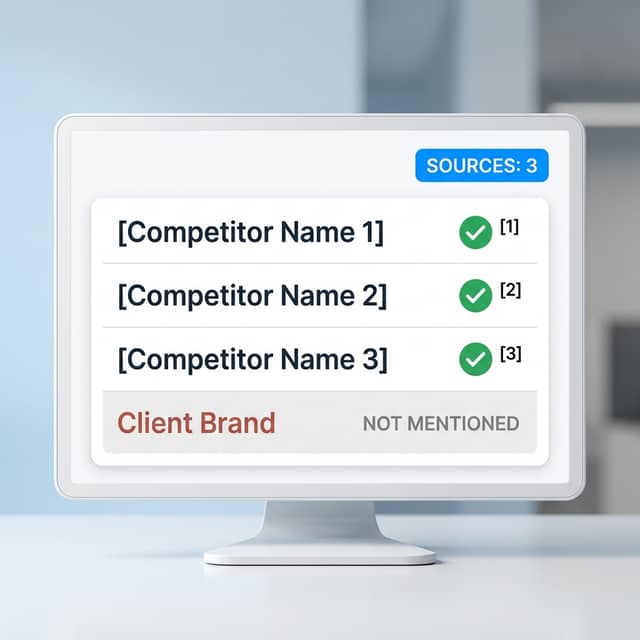
The single most powerful signal for AI recommendation selection is corroboration across multiple independent sources. When a model encounters your brand mentioned positively on review sites, industry publications, comparison articles, and community forums, it assigns significantly higher confidence to naming you. A brand that only self-promotes on its own domain creates a single-source trust problem that models are designed to avoid. Research into how third-party web mentions influence AI citations confirms that distributed brand presence across authoritative domains is the primary driver of recommendation confidence.
Review aggregators: G2, Capterra, and TrustRadius mention feed directly into how models validate category positioning
Industry publications: Guest posts and features on sites AI already indexes as authoritative carry outsized weight
Comparison content: Third-party "best of" lists that include your brand create the cross-reference pattern models rely on
Community mentions: Reddit threads, Quora answers, and Slack community recommendations signal organic trust
Expert citations: When recognized practitioners name your tool in their content, it compounds the corroboration signal
The compounding effect of third-party mentions matters as much as the initial placement. A single mention on G2 contributes one data point. A pattern of consistent mentions across G2, a relevant industry publication, and two or three practitioner blogs creates a corroboration signal that AI models treat as strong validation of category authority. This is why GoBlinkly's approach to off-site authority building focuses on distribution across source types rather than volume on a single platform.
AI engines are designed to recognize when multiple independent sources reach the same conclusion about a brand. When your SaaS product appears in a review, an expert roundup, a community thread, and a media feature, each reinforcing the same category positioning, the model's confidence in recommending you increases substantially. That is the architecture of a trustworthy entity in AI search, and it is replicable for SaaS companies of any size with a consistent, structured approach to third-party presence.
Structured Authority and Content Clarity
Models parse content for structure just as aggressively as they parse it for meaning. A page that clearly defines what a product does, who it serves, and what category it belongs to gives the model less work to do during synthesis. This matters because AI engines prioritize content they can confidently extract facts from without ambiguity. Reference-grade content for AI means pages built with clean headings, direct claims, and specific use-case language rather than vague positioning copy that reads well to humans but offers models nothing to cite.

How Do You Turn AI Engine Signals Into a Practical SaaS Recommendation Strategy?
Knowing what models weigh is step one. Translating those signals into operational moves that your marketing team can execute closes the gap between understanding and results. Each signal maps to a specific set of tactics that, when deployed consistently over 60 to 90 days, shifts your brand from absent to cited. GoBlinkly calls this the Six-Signal Authority Stack, and it is the framework we use to audit every new client's AI citation readiness before building their recommendation strategy. The companies seeing the strongest AI answer engine visibility are those treating this as a systematic channel with dedicated execution rhythms.
Category Positioning and Use-Case Specificity
AI engines don't recommend "great software." They recommend specific solutions to specific problems. When a buyer asks "what's the best onboarding tool for mid-market companies with distributed teams," the model looks for brands that have explicitly claimed that positioning somewhere in their indexed content. Generic messaging like "the all-in-one platform for modern teams" gives the model nothing to match against.
The tactical move here is buyer-question research for AI that maps the exact queries your ideal customers ask, then building content that directly addresses each one. This means creating dedicated pages or sections that name your category, your ICP, and the specific outcome you deliver, all in language that mirrors how buyers phrase their questions. Companies pursuing answer engine optimization typically start by auditing which trust signals their competitors already satisfy and then reverse-engineering the gap.
The more precisely content maps to how buyers articulate their problem, the more likely a model will surface that brand as the answer. Across GoBlinkly's client engagements, B2B SaaS brands that refined their category positioning statement to a single, specific use case saw AI citation appearances increase by an average of 2.5x within 60 days compared to brands with broad, generic category descriptions.
How Do Recency, Freshness, and Active Authority Affect AI Recommendations?
Models trained on web data have a recency bias baked into their retrieval layers. Content published six months ago carries more weight than content published three years ago, particularly in fast-moving SaaS categories. This means a one-time optimization effort decays. The brands that hold citations month after month are the ones publishing fresh, specific content that reinforces their positioning continuously.
This is where the difference between managed AEO vs in-house execution becomes stark. Most internal teams ship an initial batch of optimized content, then lose momentum as product roadmaps and quarterly priorities pull focus. The AI referral pipeline requires consistent publishing velocity, ongoing backlink acquisition, and regular refresh cycles to maintain the authority signals that keep your brand in the model's recommendation set (see AI ranking factors that actually determine your visibility). GoBlinkly structures its managed service specifically around this compounding requirement, handling the ongoing execution so that citations don't erode after the initial win. This approach reflects the dual-channel visibility framework, where strong SEO foundations feed directly into AI citation durability (see how AI engines decide what content to show).
Beyond publishing cadence, the type of content matters. Models favor pages that contain original data points, clear definitions, and structured comparisons over opinion-driven thought leadership. Building reference material that other publications link to and cite creates a compounding authority loop that models reinforce over time. The goal is not just visibility in one snapshot, but persistent presence across training data refreshes and retrieval-augmented generation pulls.

Conclusion
AI engines select recommendations through a structured evaluation of third-party validation, content clarity, category specificity, and consistent freshness. None of these signals are random, and none are outside your control. The companies winning AI answer engine visibility today are the ones treating it as a systematic channel rather than a lucky break.
Start by auditing which buyer questions already name your competitors, identify the signal gaps, and build a 90-day execution plan that addresses corroboration, structure, and recency in parallel. For B2B SaaS teams that need the full AI citation strategy built and maintained without internal lift, GoBlinkly runs the entire system from buyer-question research through ongoing authority building.
About the Author: David Mercer leads AI search and content strategy at GoBlinkly, where he helps B2B SaaS companies earn citations and recommendations across ChatGPT, Claude, Perplexity, and Gemini. He has worked with SaaS marketing teams across North America and Europe on category positioning, third-party authority building, and structured content for AI citation eligibility.
Ready to improve your AI visibility? See how GoBlinkly helps B2B SaaS brands earn citations and recommendations across leading AI engines.
Frequently Asked Questions (FAQs)
How do AI engines choose recommendations?
AI engines select recommendations by cross-referencing third-party mentions, evaluating content structure and specificity, assessing source authority, and prioritizing recent, corroborated information that directly answers the buyer's query.
How long does AEO take to work?
Most B2B SaaS companies see initial citations land within 30 to 60 days of implementing a structured answer engine optimization strategy, with compounding results over the following quarters.
Can small SaaS companies compete in AI answers?
Yes, because AI models prioritize specificity and corroboration over brand size, meaning a smaller company with precise category positioning and strong third-party validation can outrank larger competitors with generic messaging (see how answer engine optimization helps you outrank rivals on ChatGPT).
Does AI optimization work for European SaaS companies?
European SaaS AI optimization follows the same signal framework as any market, with the added advantage that region-specific content and local-language authority sources can help dominate niche queries competitors ignore.
What is the ROI of answer engine optimization for SaaS?
Industry data from Semrush (2026) shows AI referrals convert at approximately 4.4x the rate of organic search traffic, making the ROI significantly higher per visitor than traditional search-driven acquisition channels once citations are established.