Introduction
B2B customer engagement is the set of strategies and channels companies use to build relationships with buyers throughout the purchasing journey (see AI customer engagement strategies for B2B SaaS). In 2026, this includes AI answer engines, email automation, in-app messaging, and content designed to earn citations before a prospect ever visits your website. The B2B customer engagement strategy that worked in 2023 is already losing ground. Buyers no longer start their journey on a pricing page or inside a sales demo.
They start by asking AI answer engines like ChatGPT, Perplexity, and Gemini which platforms to trust, and the brands that show up in those answers capture attention before a competitor's outbound email ever lands. According to Gartner's research on the B2B buying journey, buyers now spend only 17% of their purchase cycle meeting with potential suppliers, meaning digital customer engagement during the research phase determines who makes the shortlist. The gap between companies investing in AI-era engagement and those running legacy playbooks is widening every quarter.
This guide covers engagement across the whole buying journey, starting before a prospect reaches your site: why legacy playbooks fall short, a three-step framework for mapping engagement to AI-influenced research, and the metrics that tie engagement to pipeline and retention. For earning a place in the AI answers buyers read first, see how to get recommended when buyers ask AI who to trust.

Traditional Engagement vs. AI-Driven Engagement
For years, B2B SaaS companies relied on a predictable engagement stack: email nurture sequences, gated content, webinars, and support tickets. These tactics still generate value, but they all depend on the prospect already knowing your brand exists. When AI answer engines become the first touchpoint, that assumption collapses.
Where Legacy Playbooks Fall Short
Traditional engagement playbooks assume a linear funnel where marketing generates awareness, sales qualifies interest, and customer success drives retention. The reality is that buyers now self-educate through AI-powered research before ever entering your funnel. A prospect asking "which freight TMS platforms are best for mid-market carriers" gets a curated answer from an AI engine, and if your brand is absent, you never had a chance to engage.
Discovery gap: Legacy tactics engage prospects only after they find you, while AI answers determine whether they find you at all.
Trust formation: Being cited by an AI engine carries implicit third-party endorsement that no email sequence can replicate.
Timing mismatch: Outbound campaigns reach buyers on your schedule, while AI answers meet them at the exact moment of intent.
Content utility: Gated whitepapers optimize for lead capture, while AI-optimized content earns citations by directly answering buyer questions.
The New B2B Customer Engagement Surface: AI Answer Engines
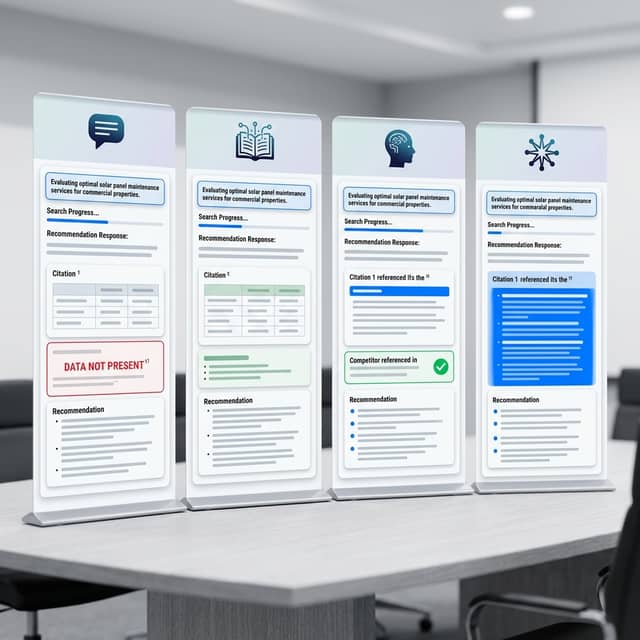
The shift here is structural, not incremental. Forrester's research on B2B buyer behavior found that twice as many buyers now name generative AI or conversational search as a more meaningful source of purchase information than vendor websites, product experts, or direct sales contact combined, describing a channel where engagement begins without the buyer clicking a single ad or opening a single email. SaaS customer engagement now requires being present inside the answers that AI models generate when prospects research solutions in your category. This means the content you publish, the authority signals you build off-site, and the structured data on your website all contribute to whether an AI engine recommends you or your competitor. Companies that treat AI visibility as a core engagement channel are capturing pipeline that competitors never see.

Building a Modern B2B Customer Engagement Framework
A modern engagement framework does not replace traditional tactics. It restructures them around the reality that a buyer's first meaningful interaction with your brand may happen inside an AI-generated answer, not on your website. The goal is to build a system where every channel, from AI citations to email sequences to product-led engagement, reinforces the others.
Step 1: Map Engagement to the AI-Influenced Buyer Journey
Start by identifying the buyer questions that drive decisions in your category. These are not generic keyword phrases. They are the specific questions prospects type into ChatGPT or Perplexity when evaluating solutions: "Which B2B customer engagement platform handles enterprise onboarding best?" or "What are the top customer engagement strategies for reducing SaaS churn?" Map each question to a stage in the buyer journey: awareness, evaluation, decision, and retention.
Once mapped, audit where your brand appears (or does not) in the answers AI engines generate for those questions. This is where GoBlinkly starts every client engagement. In a typical audit, clients discover that 60% or more of their highest-intent buyer queries return a competitor name, not theirs, inside AI-generated answers. That audit becomes the foundation for an AI strategy tailored to B2B SaaS engagement gaps. Without this data, any engagement strategy is built on assumptions about where buyers actually encounter your brand.
Step 2: Align Content, Authority, and Automation
Earning AI citations requires three coordinated inputs. First, your content must directly and thoroughly answer the questions buyers ask, structured so that AI models can parse and quote it cleanly. This means moving beyond gated lead magnets toward reference-grade content that positions your brand as the definitive source on specific topics. A strong content strategy that wins on both AI and Google serves as the backbone of this effort.
Second, off-site authority matters. AI models weigh third-party sources heavily when deciding which brands to cite. Getting featured in industry publications, earning backlinks from trusted domains, and building founder authority all contribute to how confidently an AI engine recommends you. Third, customer engagement automation still plays a critical role once a prospect enters your ecosystem. Automated onboarding flows, behavior-triggered emails, and in-app engagement sequences convert AI-sourced traffic into active users.
The difference is that these sequences now receive higher-intent leads, because a buyer who arrives via an AI recommendation has already been pre-qualified by the answer itself. B2B SaaS companies that align content, authority, and automation around AI-era buyer behavior consistently outperform those relying on legacy engagement tactics alone.
Step 3: Measure AI-Sourced Pipeline Separately
Set up separate tracking for traffic and conversions originating from AI referrals. Use UTM parameters or your CRM source fields to segment AI-sourced leads from organic and paid. Track time-to-close, deal size, and conversion rate by source. When AI-sourced leads consistently close faster and larger, the ROI case for continued investment in citation-earning content becomes self-evident.
Measuring B2B Customer Engagement: Metrics and ROI
The metrics that defined B2B customer engagement for the past decade, open rates, click-through rates, NPS scores, still hold value. But they do not capture what happens before a prospect enters your pipeline. A modern measurement framework needs to account for AI-era touchpoints alongside traditional ones.
Customer Engagement Metrics for the AI Era
Citation tracking is the new top-of-funnel metric. How many buyer-intent queries name your brand in AI-generated answers? How does that number compare to competitors? These data points reveal whether your engagement strategy is working at the discovery layer. Below that, track AI-sourced traffic separately from organic and paid channels. Segment conversion rates, time-to-close, and deal size by source to quantify customer engagement ROI from AI channels versus traditional ones.
Understanding AI growth trends in B2B SaaS helps contextualize these metrics. When you see that AI-sourced leads close faster and at higher rates, the strategic implication is clear: investment in AI visibility compounds into a durable pipeline advantage. For teams in North America evaluating their SEO strategy for driving growth, layering citation metrics on top of traditional search performance analytics gives a complete picture of engagement health.
Connecting Customer Engagement to Retention
B2B customer engagement vs customer retention is a false dichotomy when the strategy is built correctly (see customer engagement vs retention in B2B SaaS). Engagement is the mechanism; retention is the outcome. Brands that show up consistently in AI answers during the buyer's research phase build stronger initial trust, which translates directly into higher activation rates, faster time-to-value, and lower churn. The engagement does not stop at acquisition. When existing customers research adjacent problems or evaluate whether to expand their contract, AI engines influence those decisions too.
A customer engagement strategy that accounts for retention-stage AI queries, like "best practices for scaling payroll automation" when you sell HR software, keeps your brand in the conversation even after the deal closes. GoBlinkly's approach to building AI marketing strategy for founders addresses this full lifecycle, ensuring citations compound across both acquisition and retention touchpoints.

Conclusion
B2B customer engagement has expanded beyond emails, chatbots, and support portals into the AI research layer where buyers form their first impressions and shortlists. The companies winning this shift are not abandoning traditional engagement tactics; they are restructuring them around a buyer journey that now starts inside AI answer engines.
Audit where your brand appears (and where it does not appear), build reference-grade content designed to earn citations, and measure AI-sourced pipeline alongside your existing AI growth positioning for 2026. The window to build a compounding advantage in AI visibility is open now, and every month of inaction is a month your competitors' citations grow while yours do not.
Explore how GoBlinkly helps B2B SaaS companies earn AI citations and capture pipeline before the first sales conversation.
About the author: David Kross is a Content Operations Strategist at GoBlinkly, where he helps B2B SaaS companies build AI visibility strategies that earn citations across ChatGPT, Perplexity, and Gemini.
Frequently Asked Questions (FAQs)
How do B2B SaaS companies measure customer engagement in North America?
Leading B2B SaaS companies in North America measure engagement through a combination of product usage analytics, AI citation tracking, pipeline velocity by source, and retention metrics like net revenue retention and expansion rate.
Can AI improve customer engagement?
AI improves customer engagement by placing your brand directly inside the answers buyers receive during their research phase, creating a high-trust first touchpoint that traditional outbound methods cannot replicate.
What is customer engagement vs customer experience?
Customer engagement refers to the specific interactions and touchpoints a brand initiates or participates in, while customer experience encompasses the buyer's holistic perception of every interaction across the entire relationship lifecycle.
How does customer engagement affect retention?
Strong engagement builds familiarity and trust that reduces churn, and brands consistently cited in AI answers during both pre-purchase research and post-purchase problem-solving see measurably higher retention rates.
What are customer engagement channels?
Modern customer engagement channels include AI answer engines, organic search, email automation, in-app messaging, community forums, social media, webinars, and direct sales interactions. Among these, AI-driven discovery is emerging as the fastest-growing channel for B2B SaaS.
What is the difference between B2B and B2C customer engagement?
B2B customer engagement focuses on building long-term relationships with multiple stakeholders across a longer sales cycle, where trust and demonstrated expertise drive decisions. B2C engagement targets individual consumers with faster, emotion-driven purchasing. For B2B SaaS companies, this means content and AI visibility strategies must address committee-based buying rather than individual preferences.