Quick Answer
An AI Council is a cross-functional internal team, typically spanning marketing, product, sales, and an executive sponsor, that owns how your B2B SaaS brand is represented, recommended, or omitted inside AI answer engines. Standing one up in 2026 is now a leadership imperative because AI citations compound: the companies coordinating this function today are locking in visibility their competitors will spend years trying to unwind.
Introduction
B2B buyers no longer start their research on Google. They open ChatGPT, Claude, Perplexity, or Gemini and ask which vendor to trust, and the model answers with a shortlist that was decided long before the buyer typed the question. Most SaaS companies have no one internally accountable for whether they appear on that shortlist, which means marketing publishes content, product ships features, and sales chases pipeline while the actual channel deciding their future goes unmanaged. This is the governance gap an AI Council closes. Companies treating AI visibility as a coordinated discipline in 2026 are already pulling ahead of peers still treating it as a side project inside marketing.
Key Takeaways:
An AI Council is the internal governance body that owns your b2b saas growth strategy for AI answer engines across marketing, product, sales, and leadership.
Without a coordinated ai visibility framework, content, technical, and messaging decisions stay fragmented and fail to influence how models cite your brand.
Standing up this council in 2026 compounds an advantage that late movers cannot buy back once competitor citations are entrenched.

Why B2B SaaS Companies Need an AI Council Now
The shift from search rankings to model recommendations has flipped the org chart on its side. Decisions that once lived neatly inside marketing, such as messaging, content, and third-party PR, now overlap with technical decisions product owns and positioning decisions leadership sets. When no single group is accountable for how those inputs shape AI answers, the output is predictable: fragmented effort, missed citations, and competitors quietly compounding authority in the models buyers actually use.
The Cost of Leaving AI Visibility Ungoverned
Leaving AI visibility to whoever has time this quarter creates measurable drag on pipeline and brand authority. Microsoft's guidance on AI strategy and governance makes the same point at the infrastructure layer: without early governance and clear accountability, model-related decisions decay into reactive fixes. The same principle applies to how your brand shows up inside those models.
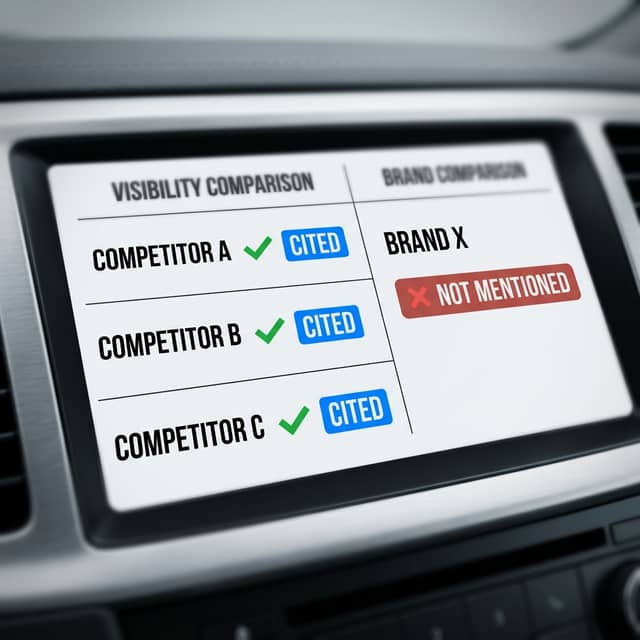
Invisible during research: If a competitor is named in AI answers to buyer-intent queries and you are not, you lose the deal before the demo is booked.
Wasted content investment: Content produced without an AI citation strategy in mind rarely gets quoted by models, even when it ranks on Google.
Duplicated or conflicting work: Marketing, product, and sales each build assets that models cannot reconcile into a clean recommendation.
No feedback loop: Without citation monitoring, no one knows which efforts moved the needle or which competitors gained ground.
Compounding disadvantage: Every month a rival's citations grow while yours stall, the gap widens faster than any single campaign can close it.
SEO vs AEO: Why the Old Playbook Falls Short
Traditional SEO optimizes for algorithms that rank pages; answer engine optimization optimizes for models that select and quote sources inside a generated answer. Both matter, but they reward different signals, and a team built only for the first will underperform on the second. Understanding this split is where a council earns its first quick win, because it forces marketing, product, and leadership to align on what the b2b saas software marketing function is actually being measured against in 2026.
Dimension | Traditional SEO | Answer Engine Optimization |
|---|---|---|
Primary outcome | Page rankings and organic clicks | Citations inside AI-generated answers |
Optimization target | Google's ranking algorithm | How LLMs select and quote sources |
Content format | Long-form, keyword-driven | Reference-grade, quotable, structured |
Authority signal | Backlinks and domain authority | Third-party sources models already trust |
Measurement | Rank, traffic, CTR | Citation frequency, share of AI voice |
Buyer touchpoint | After the search | Inside the research conversation itself |
The takeaway is not that SEO is obsolete. It is that the SEO function alone cannot execute an ai visibility framework without coordinated input from product, sales, and leadership, which is precisely what an AI Council formalizes. A sound AI strategy for SaaS visibility treats both channels as one system.

How to Build Your AI Council: Structure, Roles, and Roadmap
An effective AI Council is small, cross-functional, and empowered to make decisions rather than escalate them. MIT Sloan Executive Education's research on effective AI strategy emphasizes exactly this: cross-functional collaboration that bridges silos, paired with governance authority to act. The council should meet on a fixed cadence, own a shared dashboard, and report into leadership with the same seriousness as pipeline or product roadmap reviews.
Who Should Sit on the Council
The right council is four or five roles, not a committee. Each seat brings a specific input that shapes how models perceive the company, and each is accountable for a defined slice of the AI citation strategy. Fewer voices, clearer ownership, faster decisions. This mirrors the structure recommended in any credible AI business strategy framework for founders operating at scale.
Role | Primary Responsibility | Decisions They Own |
|---|---|---|
Executive Sponsor (CEO or CMO) | Strategic mandate and budget | Prioritization, resourcing, external partners |
Marketing Lead | Content authority and off-site signals | Editorial calendar, digital PR, citation tracking |
Product Lead | Technical parseability and messaging accuracy | Site structure, schema, product page clarity |
Sales Lead | Buyer-intent question intelligence | Query priorities, competitive framing, objection data |
SEO/AEO Specialist | Execution and monitoring | Content briefs, on-page work, citation reporting |
Notice that no seat is optional. Remove the product lead and the site stops parsing cleanly. Remove sales and the council optimizes for the wrong questions. The role most companies underweight is the executive sponsor, without whom the council cannot enforce priorities against competing quarterly goals.
Core Responsibilities and 90-Day Roadmap
The council's mandate breaks down into four ongoing responsibilities: citation monitoring, content authority, competitive tracking, and response protocols. Each maps to a measurable output, and each depends on the others to function. A council that only monitors without producing content stays informed but invisible. A council that produces content without monitoring cannot tell whether the b2b saas content authority it is building actually moves citations. HubSpot's guide to AI citation tracking lays out how visibility data converts into pipeline signal, and the council is the internal function that turns that signal into action. For a deeper look at operational execution, this framework for building AI strategy pairs well with the roadmap below.

Conclusion
The companies pulling ahead in 2026 are not the ones publishing more content or chasing more rankings. They are the ones who have named the people accountable for AI visibility, given them a mandate, and put a monthly cadence around the work. An AI Council is the mechanism that converts scattered activity into a compounding channel, and it is the organizational shift that separates SaaS leaders who get recommended by AI from those who wonder why they never do. Start with the four core seats, define the first 90 days around citation monitoring and content authority, and treat the output with the same rigor you apply to pipeline. Whether you build this function in-house or partner with a specialist, the decision that matters is choosing to own it before your competitors do.
Want to see exactly which buyer questions name your competitors instead of you across every major AI engine? Run a free competitor visibility audit with GoBlinkly to benchmark your AI citations before your council's first meeting. It pairs well with a broader look at AI growth strategies and the AI marketing strategy most SaaS founders are still missing (see AI marketing strategy for B2B SaaS founders). GoBlinkly runs the entire AEO function end-to-end, so your council can focus on strategy while execution ships every month.
Frequently Asked Questions (FAQs)
Why should SaaS companies care about AI answers?
Because B2B buyers now use ChatGPT, Claude, Perplexity, and Gemini as their first research step, and the vendors named in those answers capture demand before any sales conversation begins.
How to increase B2B SaaS leads using AI?
Focus on earning citations inside AI answer engines for buyer-intent queries, since AI referrals convert at roughly 4.4x the rate of organic search according to Semrush 2025 data.
What is the difference between SEO and AEO?
SEO optimizes pages to rank on Google, while AEO optimizes content, authority, and structure so that AI models cite your brand inside their generated answers.
How do I get my SaaS product recommended by Claude?
Publish reference-grade content that is quotable and structured, earn authority on third-party sources Claude already trusts, and monitor which buyer queries surface competitors instead of you.
How to beat competitors in AI search results?
Coordinate content, technical, and PR efforts through an AI Council so that every input reinforces the same citation strategy rather than working in isolation.
Does AI recommendation boost SaaS sales?
Yes, being cited during the AI research phase pulls high-intent buyers into the pipeline earlier and at higher conversion rates than most traditional inbound channels.
Should we build the AI Council in-house or use a managed partner?
Build the council in-house for strategic ownership, but pair it with a managed AEO partner when internal capacity cannot sustain monthly content, backlink, and monitoring execution.
About the Author
David Kross is a Content Operations Strategist focused on building scalable content systems and measurable organic growth for B2B SaaS companies. His work centers on search intent, performance analytics, and the operational frameworks that convert content investment into pipeline. He writes about the structural shifts reshaping how SaaS companies compete for visibility across both traditional search and AI answer engines.