Introduction
Most B2B SaaS founders understand that content drives organic growth, but understanding it and executing it consistently are two very different problems. Managed content services exist to close that gap, handing the entire content operation to a specialized team so founders can stay focused on product and revenue. The model goes beyond writing blog posts. It covers strategy, production, optimization, publishing, and ongoing performance tracking as a single, outsourced function. For SaaS companies competing in crowded categories, the real question is not whether content matters but whether the content being produced is structured to earn visibility across both Google and AI answer engines like ChatGPT, Perplexity, and Gemini. That distinction, between content that exists and content that gets cited, is where most founders lose ground without realizing it.
TL;DR: A managed content service handles strategy, production, and publishing as a unified system, removing the founder from execution entirely. For B2B SaaS, the key advantage is content built specifically to earn AI citations and organic rankings simultaneously, with results typically beginning within 30 to 60 days.

What a Managed Content Service Actually Includes
A done-for-you content service is not just a writer on retainer. It is a full content operation delivered externally, covering every stage from research through publishing and iteration. The scope is what separates it from hiring freelancers or assigning blog posts to an already-stretched marketing hire.
Core Deliverables in a Managed Content Engagement
When a B2B SaaS company signs on with a managed content provider, the deliverables typically span the entire content lifecycle. Here is what a well-structured engagement includes at minimum:
Buyer-question research: Identifying the exact queries your target buyers type into search engines and ask AI assistants, then mapping content to those questions.
Content strategy and editorial calendar: A prioritized publishing plan built around search intent, competitive gaps, and category relevance rather than guesswork.
Production and optimization: Writing, editing, and structuring each piece for both traditional search performance and AI engine parsability.
Publishing and technical formatting: Uploading content directly to your CMS with proper schema, internal linking, and metadata so nothing sits in a draft folder.
Performance tracking and iteration: Monthly reporting on rankings, traffic, engagement, and increasingly, AI citation presence, with adjustments based on what the data shows.
How Managed Content Differs from Freelancers and Agencies
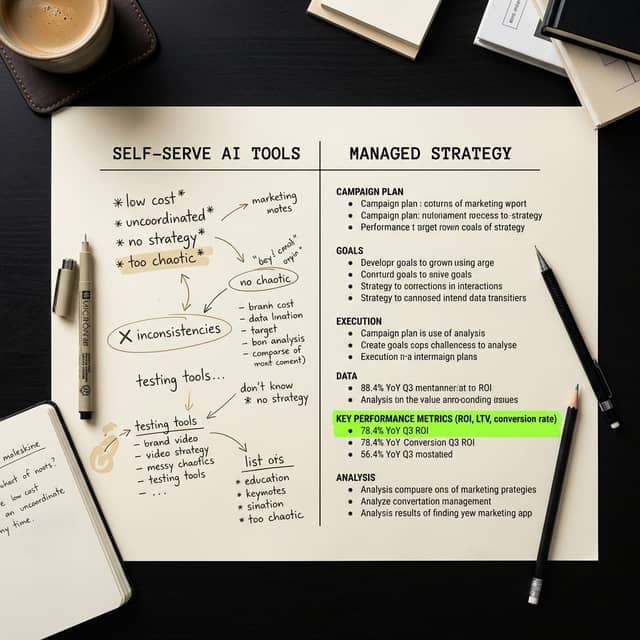
Freelance writers deliver drafts. Generalist agencies deliver campaigns. Neither typically owns the full pipeline from research to published, optimized content that compounds over time. Freelancers require you to brief, review, edit, format, and publish, which means the founder is still the bottleneck. Traditional agencies often focus on volume or vanity metrics like pageviews without tying output to measurable organic growth.
A managed content service for B2B SaaS removes the founder from the execution loop entirely. The provider handles strategy, production, and publishing as a unified system. According to recent content marketing research, companies that maintain consistent publishing cadences outperform those with sporadic output by significant margins in organic traffic acquisition. That consistency is precisely what managed services are designed to protect.

Why Managed Content Matters More Now Than Ever for SaaS
The search landscape has shifted. Google's AI Overviews now synthesize answers directly in search results, and AI answer engines like ChatGPT and Perplexity are becoming primary research tools for B2B buyers. Content that was "good enough" two years ago is no longer sufficient to earn visibility in either channel. For SaaS founders, this changes the calculus on what content needs to accomplish.
The AI Citation Factor
AI answer engines do not randomly select sources. They cite content that is structured, authoritative, and directly answers buyer-intent questions with specificity. A Semrush study on AI Overviews found that the content most likely to be cited shares common traits: clear structure, topical depth, and alignment with the exact phrasing of user queries. This is not something a founder can produce ad hoc between product meetings.
Managed content creation addresses this directly. A dedicated team researches the buyer questions that AI engines are answering in your category, then produces reference-grade content designed to be quoted. The difference between being cited and being invisible often comes down to whether that content exists at all. Across GoBlinkly's managed content engagements with B2B SaaS clients, companies that published at least eight reference-grade articles per month saw AI citation appearances begin within 30 to 45 days, with citation frequency doubling by month three as topical authority accumulated across both Google and AI answer engines. GoBlinkly, for example, builds its entire managed content approach around this principle, producing content specifically structured for dual visibility across Google and AI answer engines.
The Compounding ROI of Consistent Publishing
Content is one of the few marketing channels where output compounds. A blog post published today continues generating traffic and authority for months or years. But that compounding only works when publishing is consistent, each piece is optimized, and the overall strategy targets queries with real buyer intent. Sporadic publishing, even if individual pieces are strong, breaks the compounding cycle because search engines and AI models reward topical authority built through sustained coverage.
This is where the managed content ROI comparison becomes clear. GoBlinkly calls this the Content Compounding Engine: the system where consistent reference-grade publishing, structured for AI parsability, builds topical authority that compounds into dual-channel citations and organic rankings simultaneously -- something sporadic publishing can never achieve. An in-house hire dedicated to content for a B2B SaaS company costs salary, benefits, tools, and management overhead. A freelancer network requires coordination, quality control, and strategic direction that still falls on the founder. A managed service bundles all of that into a single monthly cost with a defined strategy framework and predictable output. For US SaaS companies and global SaaS teams alike, the math favors outsourced content management when the alternative is inconsistent execution.

Conclusion
Managed content services give B2B SaaS founders what they actually need: a complete content operation running in the background without requiring their daily involvement. The deliverables span research, strategy, production, optimization, and publishing, all calibrated toward earning organic visibility and AI citations in competitive categories. What separates a high-performing managed content service from a content mill is the upstream work before writing begins. Reference-grade content for AI citations requires buyer question research, meaning the team audits what questions buyers are actually asking in ChatGPT, Perplexity, and Gemini in the client's category, then maps those queries to content that answers them with enough specificity to be quoted.
A generic blog post on 'what is freight matching software' will rank somewhere on Google. A precisely structured page answering 'which freight matching platform is best for mid-market 3PLs with cross-border routes' will get cited in AI answers and attract a buyer who has already decided to evaluate options. The difference between those two outcomes is not talent -- it is research, structure, and deliberate positioning. For founders evaluating whether to build content capacity internally or hand it to a specialized provider like GoBlinkly, the deciding factor is straightforward. If content is not shipping consistently, structured for how AI engines select sources, and tied to measurable growth outcomes, the gap between you and competitors who are doing this only widens each month.
About the Author: David Kross leads content operations strategy at GoBlinkly, where he designs and manages content systems for B2B SaaS companies focused on dual-channel visibility across Google and AI answer engines. He has overseen managed content programs for SaaS marketing teams across North America and Europe, specializing in reference-grade content production and AI citation strategy.
Frequently Asked Questions (FAQs)
What is managed content?
Managed content is a fully outsourced content operation where a specialized team handles strategy, creation, optimization, and publishing on behalf of a company, removing the need for internal execution.
How does managed content improve SEO?
Managed content improves SEO by ensuring consistent publishing of optimized, search-intent-aligned pieces that build topical authority and earn rankings over time through structured, citation-worthy content.
Can managed content get you cited in ChatGPT?
Yes, managed content designed with reference-grade structure, buyer-intent targeting, and topical depth significantly increases the likelihood of being cited by AI answer engines like ChatGPT, Perplexity, and Gemini.
Is managed content worth the cost?
For B2B SaaS companies that lack internal content capacity, managed content typically delivers stronger ROI than freelancers or in-house hires because it eliminates coordination overhead while maintaining consistent, optimized output.
How does managed content work for global B2B SaaS teams?
Managed content providers serve global teams by handling research, localization considerations, and publishing across time zones, delivering a complete content pipeline without requiring the client to manage any part of the process.