Introduction
In 2026, the vendor a B2B buyer contacts first is increasingly decided before they visit any website. The shortlist is built inside ChatGPT, Perplexity, or Gemini and the brands not cited there are invisible at the most critical moment in the sales cycle. Instead of scrolling through ten blue links on Google, decision-makers now type high-intent questions directly into AI answer engines like ChatGPT, Claude, Perplexity, and Gemini, expecting a curated, trusted recommendation in seconds. Managed AI services have emerged as the strategic response to this shift, giving companies a way to ensure their brand is the one these models cite when buyers ask who to trust. HubSpot's analysis of answer engine optimization trends reshaping B2B discovery in 2026 confirms that brands investing in AEO now earn disproportionate attention and trust as AI search continues to grow. The challenge is that most marketing teams were built for a search engine world, and the rules governing AI visibility are entirely different. For B2B SaaS companies with real revenue on the line, understanding this category is no longer optional. It is a competitive requirement in 2026. Brands that act now will build a compounding advantage in AI-generated recommendations while those that wait will find it increasingly difficult to earn visibility dominated by early movers.

What do managed AI services actually include?
Managed AI services refer to the outsourced, end-to-end process of optimizing a brand's presence across AI-powered answer engines. Unlike a single audit or one-time content project, these engagements operate as ongoing retainers where a specialized team handles everything from research and content creation to technical restructuring and authority building. The goal is singular: make your brand the answer when AI models respond to buyer-intent queries in your category. Every deliverable in a managed AI engagement is designed to close the gap between where your brand currently appears in AI-generated answers and where it needs to be.
Core Deliverables You Should Expect
When evaluating managed AI solutions, the deliverables should map directly to the signals that AI models use to determine which sources are trustworthy and citation-worthy. A credible provider will offer a clear scope that includes the following components.
Buyer-Question Research: Identifying the exact queries your ideal customers ask AI models during their research and evaluation phases.
Content Production and Structuring: Creating and restructuring website content so it is formatted for AI consumption, not just human readability. Semrush's 2026 guide on how to optimize content for AI search engines explains how authority, structure, and trust signals determine which content AI tools choose to cite.
Authority Building: Earning backlinks, mentions, and citations from high-authority sources that AI models actively reference when generating responses.
Ongoing Monitoring: Tracking your brand's citation frequency, sentiment, and positioning across multiple AI platforms on a recurring basis.
Strategic Iteration: Adjusting content and authority tactics as AI models update their training data and retrieval methods.
How This Differs from Traditional SEO Retainers
The distinction between managed AI consulting and a traditional SEO retainer is not just semantic. Read our full breakdown of AI optimization vs traditional SEO to understand where the two approaches diverge. SEO focuses on ranking web pages in search engine results through keyword targeting, technical optimization, and link acquisition. AI optimization targets a fundamentally different output: the synthesized answer a model generates by drawing on its trained knowledge and retrieval-augmented sources. A page can rank number one on Google and still be completely absent from ChatGPT's recommendations.
Traditional SEO measures success through traffic, impressions, and keyword positions. AEO services measure success through citations, brand mentions within AI-generated responses, and the accuracy with which models represent your product's capabilities. The content structures differ too. AI models favor clear, factual, well-sourced content organized around specific questions, not the keyword-dense, long-tail pages that dominated SEO strategy for the past decade. See our full guide on how AI is changing search optimization and what it means for your content team. A brand can dominate Google rankings and still be completely invisible when a buyer asks an AI platform for a vendor recommendation.

Who actually needs managed AI services in 2026?
Not every company needs to invest in this channel today. But for a specific profile of business, the cost of inaction is already measurable. Understanding whether your organization fits this profile requires an honest look at how your buyers research solutions, what your internal team can realistically handle, and where your competitors are investing.
The Ideal Company Profile
B2B SaaS companies generating meaningful revenue are the clearest fit for managed artificial intelligence services. These businesses typically sell to buyers who conduct extensive research before scheduling a demo or signing a contract. When that research shifts from Google to AI answer engines, the brands that appear in those AI-generated recommendations gain a measurable advantage in pipeline generation.
A growing percentage of B2B buyers in 2026 now use AI platforms as their primary research tool, particularly for category comparison and vendor shortlisting, according to a 2026 State of Marketing study. Companies with annual contract values above $10,000 feel this shift most acutely because their sales cycles are longer and more research-intensive. If your buyers are asking "What is the best project management tool for mid-market teams?" or "Which compliance platforms integrate with Salesforce?", and your brand is not in the AI-generated answer, you are losing consideration before your sales team even gets a chance to engage. For B2B SaaS companies selling to research-intensive buyers, the window to build early AI citation presence is open now and it will not stay open indefinitely.
When In-House Teams Fall Short
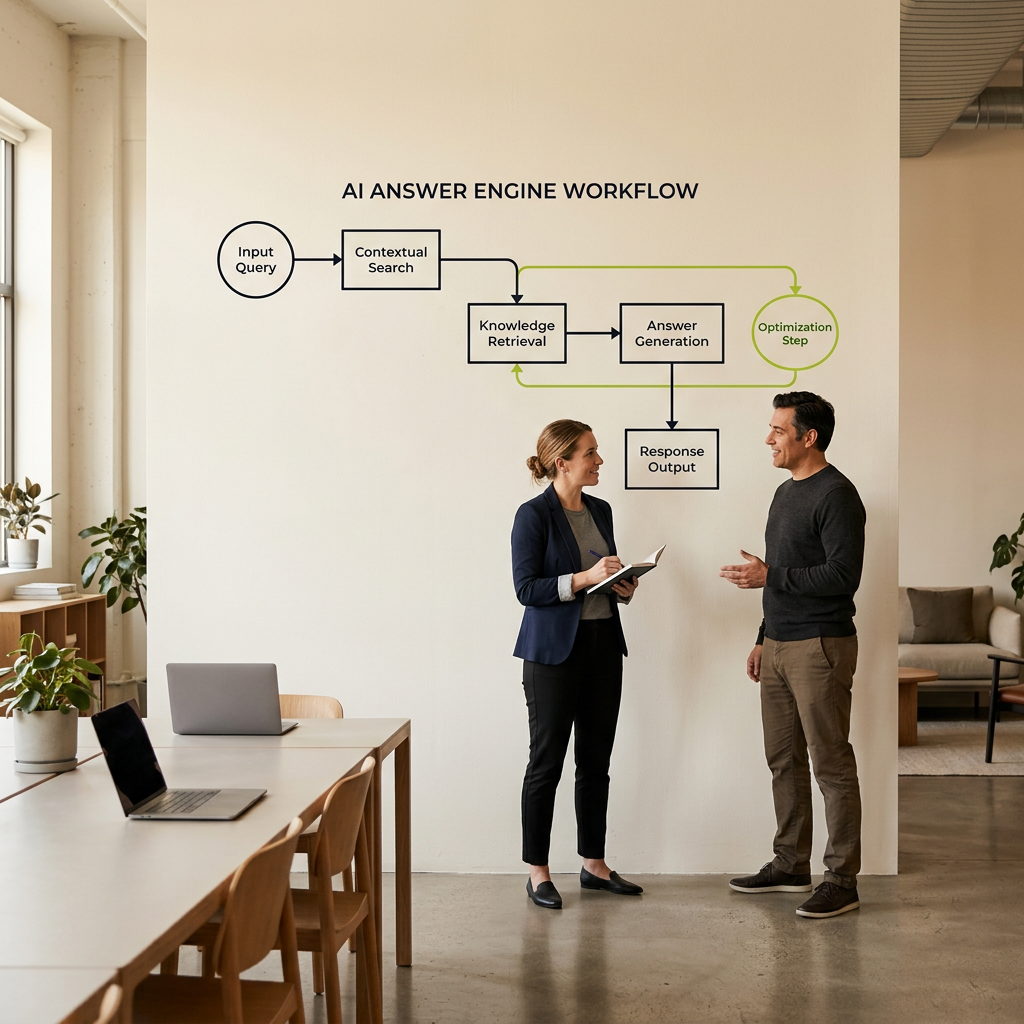
Many marketing leaders recognize the importance of AI optimization but underestimate the specialized knowledge required to execute it. Building an in-house AEO function means hiring or training people who understand how large language models process, weight, and retrieve information. It means developing a content workflow built around AI readability rather than traditional web publishing. And it means continuously monitoring a moving target, since these models update their knowledge and retrieval mechanisms on an ongoing basis. Building AI search visibility into your marketing workflow requires a completely different skill set than the one most SEO-trained content teams currently have.
For most B2B SaaS teams already stretched across demand generation, product marketing, and customer content, adding this discipline internally is not realistic. This is precisely why GoBlinkly structures its managed AI services as an extension of the client's team rather than a one-off project. The operational burden shifts to a team that does this work exclusively, while the client retains strategic oversight and benefits from a performance-backed engagement model. Companies that try to bolt AI content optimization onto their existing SEO workflow often discover that the two disciplines require fundamentally different approaches to research, structure, and measurement. At GoBlinkly, we see this every week: marketing teams that are strong at traditional SEO but have zero presence in ChatGPT, Perplexity, or Gemini vendor recommendations, losing deals before a single sales conversation begins.
How to Evaluate Whether Your Business Is Ready
Readiness for managed AI services is not just about budget. It requires alignment between your go-to-market motion, your competitive landscape, and your willingness to invest in a channel that operates on different timelines than paid advertising or event marketing. The honest answer to whether your business is ready is almost always yes if your buyers are already using AI platforms to research vendors in your category.
Five Questions to Ask Before Investing
Start by testing your current AI visibility. Open ChatGPT, Claude, or Perplexity and type the buyer-intent queries most relevant to your product category. Our step-by-step guide on how to optimize for AI search walks through exactly what to look for. Ask 'What are the best answer engine optimization tools for B2B SaaS teams?' If your brand does not appear in the response, or appears with outdated or inaccurate information, that is your baseline. The gap between where you are and where your competitors appear represents the opportunity cost of waiting.
Next, assess your content foundation. Do you have published content that clearly answers the questions your buyers ask during their evaluation process? If you are unsure where to start, read our guide on what SEO optimized content actually means and why it matters for AI visibility. Is that content structured in a way that AI models can parse and cite, or is it buried in gated PDFs and marketing pages designed to convert rather than inform? Companies with a strong existing content library often see faster results from managed AI for SaaS because there is raw material to restructure rather than a blank slate to build upon. The gap between where your brand appears today and where it needs to appear in AI-generated answers is your starting point, not a reason to delay.
What do trustworthy AI models actually look for?
AI models do not rank pages. They synthesize answers by evaluating the credibility, recency, and consistency of information across their training data and retrieval sources. Read our full explanation of how AI ranking works across every engine for a deeper breakdown. What makes content trustworthy to AI models includes factual accuracy, third-party validation through backlinks and mentions, structured formatting that makes claims easy to extract, and a consistent brand narrative across multiple authoritative sources. Our guide to on-page SEO best practices covers the structural requirements in detail. A comprehensive guide on AI visibility for B2B SaaS reinforces that brands earning citations tend to have deep, well-structured content ecosystems rather than thin marketing pages. An AI citation strategy built around structured content and credible third-party mentions is the foundation every B2B SaaS brand needs before AI engines will treat them as a default recommendation.
GoBlinkly's approach to this problem treats AI readability as a technical feature. Every piece of content produced is designed around the signals that cause models to trust a source: clear entity definitions, direct question-and-answer formatting, consistent factual claims, and authoritative external validation. This approach is not traditional content marketing repackaged with a new label. It is a distinct discipline with its own methodology and measurement framework. In our experience working with B2B SaaS clients across Canada and the United States in 2026, brands that build structured cross-referenced content ecosystems see measurable increases in AI citation frequency within the first 90 days.
Conclusion
Managed AI services represent a new category of strategic investment for B2B SaaS companies that depend on being found and trusted during the buyer research process. The shift from traditional search to AI-driven answer engines is not a future prediction; it is the current reality shaping how software buyers shortlist vendors and make purchase decisions. Companies that invest in this channel now will build a compounding advantage as AI models continue to grow their share of buyer attention, while those that wait will find it increasingly difficult to earn their way into recommendations dominated by early movers. Brands that invest in an AI citation strategy in 2026 are building a compounding asset that becomes harder for competitors to displace over time. Start with our guide to AI marketing strategy for founders to understand where to begin.
Ready to see where your brand stands in AI answer engines? Explore GoBlinkly's managed AI services and find out how to become the trusted recommendation your buyers hear first.
Frequently Asked Questions (FAQs)
What is managed AI?
Managed AI refers to the outsourced, ongoing process of optimizing a brand's visibility, accuracy, and citation frequency across AI answer engines like ChatGPT, Claude, Perplexity, and Gemini.
What is the difference between SEO and AEO?
SEO focuses on ranking web pages in traditional search engine results, while AEO (Answer Engine Optimization) focuses on getting your brand cited and recommended within AI-generated answers to buyer queries.
Why do I need AEO services?
You need AEO services because an increasing share of B2B buyers now research solutions through AI platforms, and if your brand is absent from those AI-generated responses, you lose consideration before your sales team can engage.
Which companies benefit most from managed AI services?
B2B SaaS companies with established revenue, longer sales cycles, and buyers who conduct extensive online research before purchasing benefit most from managed AI services.
How does AI content optimization work?
AI content optimization works by structuring, producing, and distributing content in formats that AI models can easily parse, verify, and cite, while building the third-party authority signals that cause those models to trust your brand as a credible source.