Introduction
There are reportedly over 200 Google ranking factors, and the internet is flooded with conflicting advice about which ones matter (see Google ranking factors that still matter). For founders trying to grow organic traffic without a dedicated SEO team, this noise creates a real problem: wasted effort on signals that barely move the needle while high-impact factors go ignored. The truth is that a small cluster of search engine ranking factors drives the vast majority of results, and understanding them gives you a disproportionate advantage. Founders who nail these fundamentals show up consistently, while competitors who chase every algorithmic rumor stay buried on page three.

The On-Page Factors That Set the Foundation
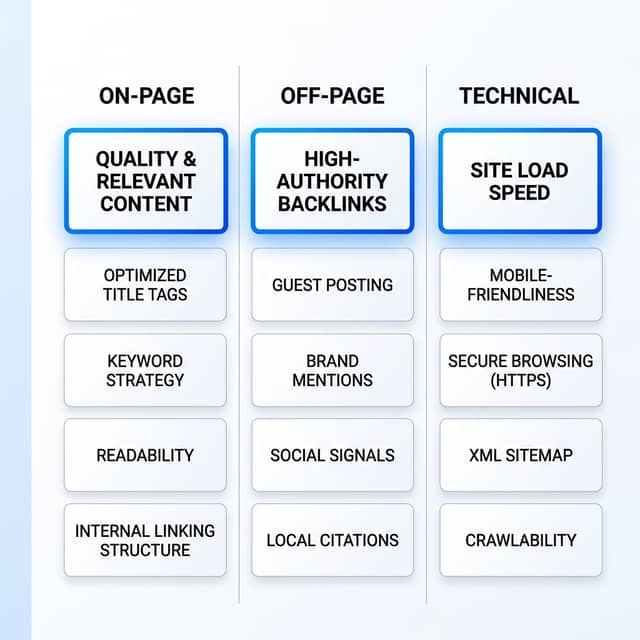
On-page SEO factors are the elements you control directly on your website, from the words on the page to the HTML structure behind them. These are typically the first signals Google evaluates when deciding what a page is about and whether it deserves to rank. Getting on-page elements right does not guarantee top positions, but getting them wrong almost guarantees invisibility.
Content Relevance and Search Intent Alignment
Google's primary job is matching a search query with the most relevant, useful result. That means your content needs to directly answer the question behind a keyword, not just mention it a few times. Keyword research is where this starts: understanding what your audience is actually searching for and what they expect to find when they click. Content quality ranking factors boil down to whether the page genuinely satisfies the searcher or sends them back to Google looking for a better answer.
- Title tags and H1s: These tell Google and users exactly what the page covers, so they need to include your primary keyword naturally and match the search intent behind it.
- Header hierarchy: Structured H2s and H3s help Google parse the page's subtopics, making it easier to rank for related queries and appear in featured snippets.
- Internal linking: Linking between related pages distributes authority and helps search engines crawl your site more efficiently, directly boosting the pages you want to rank.
- Meta descriptions: While not a direct ranking signal, a well-written meta description improves click-through rate, which indirectly influences how Google perceives your page's value.
Effective content optimization ensures these on-page elements work together to signal relevance to both traditional search engines and AI platforms.
E-E-A-T and Why Google Cares Who Wrote Your Content
E-E-A-T stands for Experience, Expertise, Authoritativeness, and Trustworthiness. It is not a single algorithm score but a framework Google's quality raters use to evaluate whether content deserves to rank. For founders, the practical takeaway is straightforward: pages that demonstrate real knowledge and credibility outperform generic content written by no one in particular. As Search Engine Journal explains, demonstrating first-hand experience is now a critical component of how Google assesses trustworthiness. Adding author bios, citing sources, and publishing content grounded in actual business experience all strengthen E-E-A-T ranking signals without requiring any technical changes to your site.

Off-Page and Technical Signals That Multiply Your Results
On-page optimization gets you into the conversation, but off-page and technical SEO ranking factors determine how high you climb. These signals operate behind the scenes, reinforcing your content's authority and ensuring Google can actually find, crawl, and render your pages properly. Founders who ignore this layer often wonder why great content sits at position 15 instead of position 5.
Backlinks: The Authority Signal That Still Dominates
Backlink ranking factors remain one of the strongest predictors of where a page will rank. When a reputable site links to your content, Google interprets it as a vote of confidence. The quality of the linking domain matters far more than the raw number of links. One editorial link from an industry publication carries more weight than dozens of links from low-quality directories.
Building backlinks as a founder means creating content worth referencing: original data, unique frameworks, or genuinely helpful guides that other sites want to cite. Guest posting, partnerships, and digital PR all work, but the foundation is always content that earns attention organically. As Backlinko's research confirms, the correlation between high-quality backlinks and top rankings remains one of the most consistent findings in SEO studies. Understanding on-page vs off-page ranking factors helps you allocate effort correctly: fix your pages first, then invest in link building to amplify what is already working.
Technical Health: The Invisible Deal-Breaker
Technical SEO covers everything from site speed to crawlability to mobile responsiveness. If Google cannot efficiently crawl and index your pages, no amount of great content or strong backlinks will help you rank. Page speed as a ranking factor has been confirmed by Google repeatedly, and slow-loading pages lead to higher bounce rates and lower conversions beyond just the ranking impact. Core web vitals, Google's specific metrics for measuring page experience, evaluate loading performance, interactivity, and visual stability. Avoiding common SEO strategy mistakes means understanding that technical health cannot be an afterthought but must be part of your foundational approach.
For founders, a technical SEO audit should be one of the first things you complete. Check that your site has a clean XML sitemap, no broken internal links, proper canonical tags, and mobile-friendly design. Core web vitals vs other ranking factors is a common debate, but the consensus is clear: technical health is a baseline requirement, not a competitive edge. You will not outrank competitors on technical SEO alone, but you will lose to them if yours is broken.

Conclusion
The SEO ranking factors that actually move results for founders come down to a focused set: relevant content aligned with search intent, strong E-E-A-T signals, quality backlinks, and a technically sound website. You do not need to optimize for hundreds of signals. You need to master the handful that compound over time and build real search visibility. Founders who treat these fundamentals as the backbone of their SEO strategy position themselves to rank not just on Google, but across AI engines that increasingly pull from well-structured, authoritative content. The window to build this foundation is now, before competitors lock in the visibility you are leaving on the table.
Ready to stop guessing at ranking factors and start showing up? GoBlinkly handles the entire content and SEO pipeline so founders can focus on building their business.
Frequently Asked Questions (FAQs)
What are the most important Google ranking factors?
The most impactful factors are content relevance and search intent alignment, high-quality backlinks from authoritative domains, E-E-A-T signals, and a technically healthy site with fast load times and mobile responsiveness. These factors work together as a system: strong content without technical health will underperform, just as a fast site with weak content will struggle to rank competitively.
How does page speed affect rankings?
Slow page speed increases bounce rates and signals poor user experience to Google, which can directly lower your position in search results, especially on mobile. Pages loading in under 2.5 seconds consistently outrank slower competitors, and this speed threshold has become critical as AI engines also prioritize fast-loading sources when selecting content to cite.
What is E-E-A-T in SEO?
E-E-A-T stands for Experience, Expertise, Authoritativeness, and Trustworthiness, and it is the framework Google uses to assess whether content is credible and deserving of high rankings. Building E-E-A-T requires demonstrating real-world experience, citing credible sources, earning mentions from authoritative sites, and maintaining transparency about who creates your content.
How do backlinks affect rankings?
Backlinks function as votes of confidence from other websites, and links from reputable, topically relevant domains signal to Google that your content is authoritative enough to rank higher. Quality matters far more than quantity: one link from a trusted industry publication carries more ranking power than dozens of links from low-quality directories.
How do local SEO ranking factors differ from national rankings?
Local SEO ranking factors place heavy emphasis on Google Business Profile optimization, local citations, proximity to the searcher, and reviews, whereas national rankings rely more on domain authority and broad content relevance. Local businesses should focus on consistent NAP (Name, Address, Phone) data, gathering customer reviews regularly, and creating location-specific content that addresses local search intent.