Quick Answer
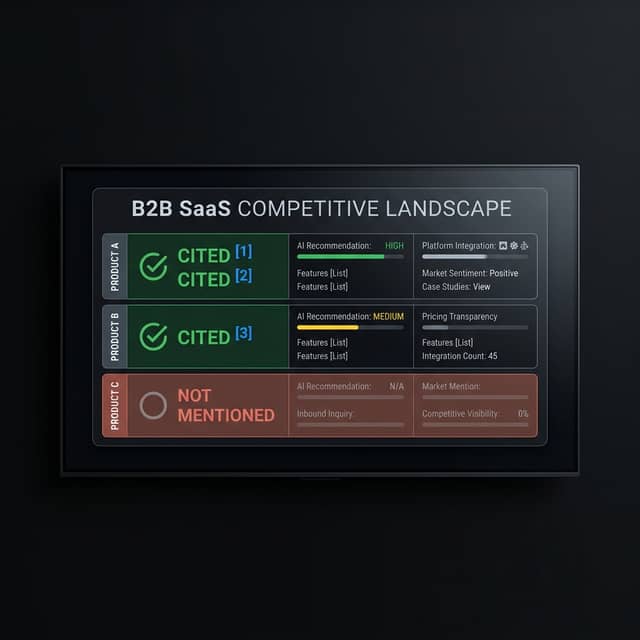
Your B2B SaaS is invisible on ChatGPT and Perplexity because these engines cite content structured for extraction and backed by third-party authority, not pages ranked on Google. Answer engine optimization (AEO) fixes this by researching buyer questions, restructuring your site for AI parsing, publishing reference-grade content, and earning citations on sources AI already trusts. In 2026, skipping AEO means competitors compound citations while your pipeline quietly shrinks.
Introduction
Ask ChatGPT which vendor solves the exact problem your product solves. If a competitor's name appears and yours does not, you are already losing pipeline you will never see in your CRM. B2B buyers now shortlist vendors inside AI answer engines before a discovery call is ever booked, and most SaaS marketing teams are still measuring Google rankings that no longer reflect where the decision starts. AI search visibility is decided by citation logic, not ranking logic, and the gap between the two widens every quarter. That gap is where 2026 revenue is quietly being reassigned.
Key Takeaways:
AI answer engines cite sources based on structure, clarity, and third-party authority, not traditional Google ranking signals.
AEO requires buyer-question research, site restructuring, reference-grade content, and off-site citations working together.
Every month without AEO lets competitors accumulate citations that compound into a defensible visibility moat.

Why B2B SaaS Brands Are Missing from AI Answers
Buyers used to open ten tabs and compare vendors themselves. Now they ask an AI to do it for them, and the answer often names three vendors and stops. If your brand is not one of the three, the buyer moves on without ever knowing you exist. This is the new top of funnel, and it operates on entirely different rules than the SEO playbook most SaaS teams still run.
How AI Search Actually Selects Vendors
AI answer engines pull from training data, live retrieval, and trusted third-party sources to construct a response. They favor content that is explicit, structured, and corroborated across multiple domains. This is a fundamentally different mechanism from Google's blue links, and it explains why ranking on page one no longer guarantees you show up in AI-driven buyer research.
Extractability: Content must be written so a model can lift a clean, self-contained answer without ambiguity.
Corroboration: Claims are trusted more when independent sources repeat them across the open web.
Freshness: Recent, dated content signals current relevance and gets pulled into live retrieval more often.
Authority signals: Mentions on industry publications, comparison sites, and analyst content weigh heavily.
Query alignment: Content must map directly to the natural-language questions buyers actually ask.
Why Traditional SEO Does Not Translate
Ranking well on Google trains teams to optimize for keywords, backlinks, and dwell time. AI engines care about whether your content can be quoted verbatim as a trustworthy answer. A page stuffed with keywords may still rank on Google yet be completely skipped by ChatGPT because it lacks the crisp, extractable structure models prefer. HubSpot's own analysis of answer engine best practices makes the same point: format and clarity now outrank keyword density in AI selection logic. The result is that many SEO-strong SaaS brands are structurally invisible in the exact channel where their buyers now start.
What AEO Actually Requires in Practice
AEO is not a content refresh or a schema plugin. It is a coordinated program across research, technical structure, content production, and off-site authority. Skipping any one of the four leaves gaps that AI engines interpret as low confidence, and low confidence means no citation.
The Four Pillars of Answer Engine Optimization
A working AEO program covers buyer-question research, site restructuring, reference-grade content, and third-party authority in parallel. Google's own AI optimization guidance confirms that crawlability and indexability remain non-negotiable fundamentals, even as the specific tactics for earning citations continue to evolve. Teams that treat AEO as a bolt-on rarely see citations land, while teams that run all four pillars together typically see first mentions within 30 to 60 days. For SaaS marketing leaders trying to understand AEO versus traditional SEO, the shift is from ranking-first to citation-first thinking.

AEO vs SEO: How the Two Channels Compare
Most SaaS leaders assume AEO is a subset of SEO. It is not. The channels overlap in some technical fundamentals but diverge sharply in objectives, success metrics, and time horizons. Understanding the difference is what separates teams that budget correctly from teams that expect their existing agency to handle both.
Side-by-Side Comparison for B2B SaaS Marketing Leaders
The table below lays out the operational differences that matter when deciding how to allocate marketing budget in 2026.
Dimension | Traditional SEO | Answer Engine Optimization |
|---|---|---|
Primary goal | Rank on Google SERPs | Get cited by AI answer engines |
Success metric | Keyword rankings and organic traffic | Citations across ChatGPT, Perplexity, Claude, Gemini |
Content style | Long-form, keyword-optimized | Structured, extractable, question-first |
Authority signal | Backlinks and domain authority | Third-party mentions on AI-trusted sources |
Buyer intent captured | Active search on Google | Vendor shortlisting inside AI research |
Conversion rate | Baseline organic conversion | Roughly 4.4x higher per Semrush 2025 data |
The takeaway is that SEO and AEO are complementary but distinct disciplines. Treating AEO as a content tweak inside an SEO retainer is why so many brands remain invisible to AI even after years of SEO investment. This is also why competitors get AI mentions that your equally strong content does not.
Why 2026 Raises the Stakes
AI referral volume has moved from experimental to material for B2B SaaS in less than eighteen months. HubSpot's recent look at AEO adoption trends shows buyer discovery is shifting fast enough that a two-quarter delay meaningfully changes competitive position—citations compound. Once a competitor is consistently named for a buyer question, models reinforce that association on every subsequent query, making it progressively harder to displace them. GoBlinkly built its practice specifically around this compounding effect, which is why its engagements typically produce first citations inside 30 to 60 days and expand coverage every month after.
How to Start Building AI Search Visibility
The first move is diagnostic, not creative. You cannot fix invisibility you have not measured, and most SaaS teams have no idea which buyer questions currently name a competitor instead of them across ChatGPT, Perplexity, Claude, and Gemini.
The Practical AI Search Optimization Checklist
Start with a visibility audit that surfaces every high-intent buyer question in your category and shows who gets cited today. From there, prioritize the questions with the highest purchase intent, restructure the pages that should answer them, publish reference-grade content on the gaps, and begin earning citations on the third-party sources AI engines already trust. Teams without internal capacity should evaluate a managed partner rather than stall, since the challenge of driving AI visibility without internal lift is exactly what causes most in-house AEO efforts to lose to shipping product.
What to Look for in an AEO Partner
Not every agency claiming AEO expertise actually executes on citations. Look for transparent pricing, published methodology, engine-specific tracking, and outcome-based guarantees rather than vanity metrics like traffic or rankings. GoBlinkly, for example, publishes tiered pricing starting at $2,500 per month, tracks citations across all major engines at higher tiers, and backs every engagement with a 90-Day Promise that refunds clients who are not cited on ChatGPT for at least three buyer-intent queries. That model reflects a healthy content strategy for AI citations that treats results, not activity, as the deliverable.

Conclusion
B2B buyers are already asking AI who to trust, and the answer is being decided in citations you cannot see on your analytics dashboard. AEO is the discipline that puts your brand inside those answers, and it operates on a different mechanic than the SEO your team already runs. Waiting one more quarter does not preserve the status quo; it lets a competitor's citations harden into a default recommendation. The teams winning in 2026 are the ones treating AI search as a standing channel, not an experiment. Start with a visibility audit, then decide whether to build internally or bring in a partner who has already solved it.
Curious where your brand actually stands inside ChatGPT and Perplexity today? Request a free competitor visibility audit from GoBlinkly to see exactly which buyer questions name a competitor instead of you across every major AI engine.
Frequently Asked Questions (FAQs)
What is AI search optimization?
AI search optimization is the practice of structuring content, site architecture, and off-site authority so AI answer engines like ChatGPT and Perplexity cite your brand when buyers ask category-defining questions.
Why is my SaaS invisible on ChatGPT?
Your SaaS is likely invisible because your content is not structured for extraction and your brand lacks corroborating mentions on the third-party sources AI models weight most heavily when constructing answers.
How does AEO differ from SEO?
AEO optimizes for citations inside AI-generated answers using extractable structure and third-party authority, while SEO optimizes for Google rankings using keywords, backlinks, and on-page signals.
How long does it take to get cited by AI?
Most well-executed AEO programs produce first citations within 30 to 60 days, with coverage expanding across more buyer questions and engines each subsequent month.
Is AEO worth it for B2B SaaS?
Yes, because AI referrals convert at roughly 4.4x the rate of organic search according to Semrush 2025 data, meaning even modest citation volume can meaningfully move pipeline for B2B SaaS.
How much does an AEO agency cost per month?
Managed AEO services typically range from $2,500 to $7,500 per month depending on engine coverage, content volume, backlink production, and whether a dedicated strategist is included.
How do I get my brand cited on Perplexity?
You get cited on Perplexity by publishing extractable, question-first content on your own site and earning corroborating mentions on the industry publications and comparison sources Perplexity retrieves most frequently.
About the Author
David Mercer is an AI Search and Content Strategist focused on helping B2B SaaS brands translate SEO fundamentals into measurable AI search visibility. His work centers on research-backed content frameworks, technical structuring for answer engines, and citation-driven authority building. He writes to help marketing leaders act on AEO with clarity rather than guesswork.